If you own a home built before 1990, understanding this risk is crucial. This guide will walk you through everything you need to know about identifying vermiculite, understanding the dangers, and navigating the safe, professional removal process to protect your family and your property value.
TL;DR: Key Takeaways on Vermiculite
- Most vermiculite insulation in the U.S. came from a mine contaminated with asbestos.
- The EPA advises homeowners to assume all vermiculite insulation contains asbestos.
- Asbestos fibers are dangerous only when airborne; do not disturb the insulation.
- Qualifying homeowners may be eligible for partial reimbursement through the Zonolite Attic Insulation (ZAI) Trust - contact us or the Trust to confirm current reimbursement terms.
- Safe removal is a job for licensed certified professionals following EPA, OSHA, and DEP regulations.
What is Vermiculite Insulation and Why is it a Health Concern?
Vermiculite is a naturally occurring mineral that expands when heated, creating lightweight, fire-resistant, and absorbent pebbles. These properties made it an excellent and widely used insulation material for much of the 20th century, poured loosely into attic floors and wall cavities.
The health concern stems not from the vermiculite mineral, but from its frequent contamination with asbestos.
The Story of Zonolite and the Asbestos Connection
According to the U.S. Environmental Protection Agency (EPA), a single mine near Libby, Montana, was the source for over 70% of all vermiculite sold in the U.S. from 1919 to 1990. This vermiculite, sold under the brand name Zonolite, was contaminated with a type of asbestos called tremolite-actinolite.
Because Zonolite dominated the market for so long, the EPA’s official guidance is clear: homeowners should assume that if their home has vermiculite insulation, it is contaminated with asbestos.
The Health Risks of Airborne Asbestos Fibers
The danger of asbestos lies in its microscopic, sharp fibers. When materials containing asbestos are disturbed—during renovations, cleaning, or even from vibrations—these fibers can become airborne and easily inhaled.
Once lodged in the lungs, these fibers can cause serious and often fatal diseases, including:
- Asbestosis: A chronic, progressive lung disease that causes scarring of lung tissue and severe shortness of breath.
- Lung Cancer: Inhaling asbestos fibers significantly increases the risk of developing lung cancer.
- Mesothelioma: A rare and aggressive cancer that affects the lining of the lungs, chest, or abdomen.
These diseases have a very long latency period. The time between first exposure and a diagnosis can be 20 to 40 years or even longer, meaning the danger from a disturbance today might not become apparent for decades.
How to Identify Vermiculite Insulation in Your Home
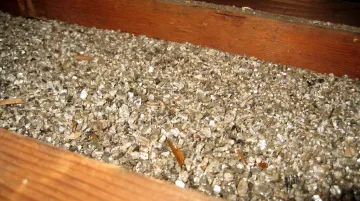
Identifying vermiculite insulation often starts with a visual check, but only professional lab testing can confirm if it contains asbestos. Look for it primarily in your attic, poured loosely between the joists, or sometimes inside masonry block walls.
Visual Characteristics:
- Appearance: Small, loose, pebble-like or flaky particles.
- Color: Typically grayish-brown or silvery-gold.
- Texture: The particles are lightweight and may have shiny flakes, resembling mica. Upon close inspection, they often have an accordion-like shape.
Safety Warning: Do NOT disturb suspected vermiculite insulation. Do not sweep it, vacuum it, or store items on top of it. Limit access to the area, especially for children, and seal off any cracks or holes in the ceiling below. Professional testing is the only definitive and safe way to confirm if asbestos is present.
The Professional Vermiculite Removal Process: A Step-by-Step Guide
Vermiculite abatement requires a licensed and certified professional, especially in states with strict regulations like Massachusetts and New Hampshire. Following proper abatement procedures ensures compliance with EPA, OSHA, and MassDEP regulations and protects occupants from exposure.
Here’s what you can expect from a professional removal process.
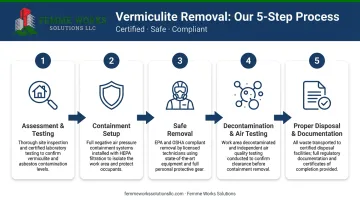
Step 1: Professional Assessment and Testing
The process begins when a certified asbestos contractor inspects the area. They will take a few small samples of the insulation according to strict safety protocols and send them to an accredited laboratory for analysis to confirm the presence and type of asbestos.
Step 2: Containment and Site Preparation
Before any removal begins, the work area must be completely isolated from the rest of your home. A professional team, like the experts at Femme Works Solutions, will:
- Seal off all doorways, vents, and other openings with heavy plastic sheeting.
- Establish a negative air pressure system with HEPA-filtered machines to ensure contaminated air cannot escape the containment zone.
- Disable your home’s HVAC system to prevent the circulation of airborne fibers.
Step 3: Safe Removal and Abatement
Technicians wearing full Personal Protective Equipment (PPE) enter the contained area to perform the removal. They use specialized methods to minimize dust, such as wetting the insulation, and employ industrial-grade HEPA-filtered vacuums and hand tools to carefully extract every particle of vermiculite.
Step 4: Decontamination and Air Clearance Testing
Once all vermiculite is gone, every surface inside the containment zone is meticulously cleaned using HEPA vacuums and wet-wiping techniques.
After cleaning, an independent, third-party air monitoring professional conducts aggressive air sampling. This testing ensures the asbestos fiber count is below the EPA's clearance level, certifying the area is safe for re-entry.
Step 5: Proper Disposal and Documentation
Contaminated materials, including the vermiculite, plastic sheeting, and used PPE, are double-bagged, sealed, and labeled for transport to a licensed hazardous waste facility. Upon completion, you receive official documentation certifying the work was performed according to all federal and state regulations.
Navigating the Cost and Financial Assistance for Vermiculite Removal
Removing vermiculite is an investment in your family's health and your home's value. The final cost depends on an individual assessment of the job — including the size of the area, accessibility, depth of insulation, local disposal fees, and site conditions. Request a free quote from Femme Works Solutions for an accurate figure based on your specific property.
What Factors Influence the Cost of Removal?
The price for professional vermiculite abatement varies based on:
- Size of the area: The total square footage of the attic or walls.
- Accessibility: How difficult it is to access the space (e.g., tight crawlspaces vs. open attics).
- Depth of insulation: The volume of material that needs to be removed.
- Local disposal fees: Costs for hazardous waste disposal vary by region.
The ZAI Trust: Get Reimbursed for Removal Costs
To help homeowners with the expense, the Zonolite Attic Insulation (ZAI) Trust was established to reimburse a significant portion of removal and re-insulation costs. An experienced contractor can help you navigate the claims process.
To be eligible, you need proof that your insulation is the Zonolite brand, which the Trust confirms through its own sampling process. Qualifying homeowners may be eligible for partial reimbursement through the Zonolite Attic Insulation (ZAI) Trust - contact us or the Trust to confirm current reimbursement terms.
Important: You must start the claim process with the ZAI Trust before you begin the removal project to ensure you meet all requirements.
Protect Your Home with Certified Removal
Discovering you have vermiculite insulation can be stressful, but taking action is straightforward. Here’s a clear path forward:
- Assume the insulation contains asbestos for safety.
- Remember it's only a risk when disturbed, which provides peace of mind.
- Hire a licensed certified professional for removal — this is the only safe and legally compliant solution under State, DEP, and EPA regulations.
Hiring a certified, experienced, and insured contractor is non-negotiable.
With over 15 years of experience, Femme Works Solutions is a fully licensed, woman-minority-owned business compliant with all EPA, OSHA, and DEP regulations. Our team is dedicated to ensuring your home is safe for you and your family.
If you suspect you have vermiculite insulation in your Massachusetts or New Hampshire home, contact Femme Works Solutions today for a professional inspection and a transparent, no-obligation quote.
Frequently Asked Questions
How likely is vermiculite to have asbestos?
Extremely likely. Since over 70% of vermiculite insulation in the U.S. originated from an asbestos-contaminated mine, the EPA advises assuming it all contains asbestos. Always take professional safety precautions.
Should vermiculite be removed?
The EPA suggests leaving it undisturbed in enclosed areas like an unused attic. However, removal is necessary if you plan to renovate, use the space for storage, or want to guarantee your home is completely free of asbestos risk.
How much does it cost to have vermiculite removed?
The cost depends on an individual assessment of the job - including attic size, accessibility, insulation depth, and local disposal fees. Qualifying homeowners may be eligible for partial reimbursement through the Zonolite Attic Insulation (ZAI) Trust - contact us or the Trust to confirm current reimbursement terms. Contact Femme Works Solutions for a free quote.
Can you sell a house with vermiculite?
Yes, but you must disclose it to buyers in Massachusetts, which can lower property value. Professional removal and documentation are valuable selling points that make the process smoother and protect your home's value.