Vermiculite itself is a naturally occurring mineral. The problem is that for decades, over 70% of the vermiculite sold in the U.S. came from a mine in Libby, Montana, that was also home to a natural asbestos deposit. This means countless homes were insulated with a material that poses a hidden risk.
This guide will walk you through everything you need to know. We'll cover how to identify vermiculite, the critical importance of testing before you touch it, safe testing procedures, and what to do once you have the results.
TL;DR: Key Takeaways on Vermiculite Asbestos Testing
- Assume all vermiculite insulation contains asbestos until a certified lab proves it doesn't.
- Never disturb or try to remove vermiculite yourself; asbestos is most dangerous when airborne.
- Hiring a certified professional for sampling and testing is the safest approach — never disturb vermiculite without proper containment and expertise.
- If your test is positive, a licensed asbestos abatement professional is required for safe removal.
- Financial aid may be available from the Zonolite Attic Insulation Trust if your insulation qualifies.
What is Vermiculite Insulation and How to Identify It
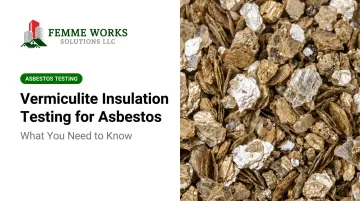
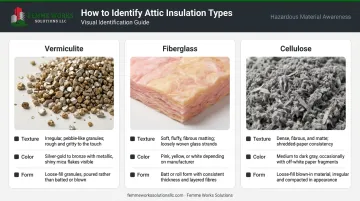
Vermiculite insulation is a loose-fill or pour-in product, meaning it was typically poured into attic floors or wall cavities, filling the space between joists. It has a distinct appearance that sets it apart from other common insulation types.
Look for a material that is:
- Pebble-like in texture, with particles ranging from very fine to nearly an inch long.
- Lightweight and flaky.
- Gray-brown or silver-gold in color, often with shiny flakes that catch the light, similar to mica.
It's most commonly found in the attics of homes built before 1990, but it can also be in wall cavities. Don't confuse it with fiberglass insulation, which comes in pink, yellow, or white batts or rolls, or cellulose, which is a gray, fibrous material that looks like shredded paper.
Why You Must Assume Vermiculite Contains Asbestos
The link between vermiculite and asbestos is a matter of historical record. According to the U.S. Environmental Protection Agency (EPA), a single mine near Libby, Montana, was the source of over 70% of all vermiculite sold in the United States from 1919 to 1990.
The product sold from this mine was most often marketed under the brand name Zonolite. Because the mine also had a large, natural asbestos deposit, the vermiculite extracted was contaminated.
When inhaled, asbestos fibers can lead to serious and often fatal health conditions, including:
- Asbestosis, a chronic lung disease that causes scarring of lung tissue.
- Lung Cancer, a leading cause of cancer-related deaths.
- Mesothelioma, a rare and aggressive cancer of the lining of the lungs, chest, or abdomen.
The EPA states there is no known safe level of asbestos exposure. Because it's impossible to tell if your vermiculite is contaminated by sight alone, the EPA's guidance is clear: assume it contains asbestos and do not disturb it.
How to Test Vermiculite Insulation for Asbestos
Testing is the only way to know for sure if your insulation contains asbestos. This step is non-negotiable before any renovations, repairs, or even minor work that could disturb the material. The safest approach is always to hire a certified asbestos professional for sampling and testing.
The Recommended Method: Hiring a Certified Professional for Asbestos Inspection and Testing
This is the safest and most recommended option. Certified asbestos inspectors are trained to collect samples without causing contamination. They follow strict protocols and work with accredited asbestos testing laboratories to ensure accurate, reliable results.
When you hire a professional, you can expect a thorough process:
- A certified inspector will perform a site assessment.
- They will collect samples according to strict regulatory protocols (like the EPA's AHERA standard).
- You will receive a detailed report with the lab's findings and clear recommendations.
For example, a local firm like Femme Works Solutions can manage this entire process. A Massachusetts-licensed team will follow all EPA, OSHA, and DEP regulations, ensuring the inspection is done safely and correctly from start to finish.
Interpreting Your Test Results and Next Steps
A few days after submission, the lab will provide a report indicating whether asbestos was detected and, if so, at what percentage. Your next steps depend entirely on these results.
If Your Test Results are Negative
If a reputable, accredited lab finds no asbestos in your samples, the insulation is considered safe. You can proceed with your planned renovations or insulation work.
If Your Test Results are Positive
First, do not panic and do not disturb the insulation. The immediate danger from asbestos comes from making the fibers airborne. As long as it remains contained and undisturbed, the risk is minimal.
Here's what to do next:
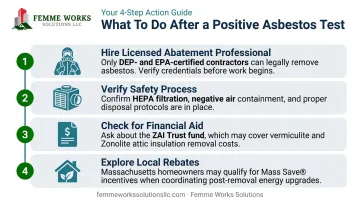
- Hire a Licensed Abatement Professional. In Massachusetts and New Hampshire, you must use a licensed contractor who follows strict State, DEP, and EPA requirements for containment, removal, and disposal.
- Verify the Contractor's Process. A certified company like Femme Works Solutions will use state-of-the-art equipment, including negative air systems and HEPA air scrubbers, to ensure fibers are contained and your home remains safe.
- Check for Financial Assistance. If your insulation is the Zonolite brand, you may be eligible for partial reimbursement (up to 55% of costs) through the Zonolite Attic Insulation (ZAI) Trust.
- Explore Local Rebates. In Massachusetts, the Mass Save® program may help cover costs for barrier mitigation like vermiculite removal. As a participating contractor, Femme Works Solutions can help you navigate the process.
Safety Precautions and Common Mistakes to Avoid
Whether you're waiting for test results or know you have asbestos-containing vermiculite, follow these critical safety rules.
- DO minimize attic access entirely and contact a certified professional before entering an area with suspected vermiculite. If entry is unavoidable in an emergency, consult a licensed expert first about appropriate protective measures.
- DO seal off any cracks, holes, or drafts from the attic into your living space. Check around light fixtures, attic hatches, and plumbing pipes.
- DON'T store boxes or personal belongings in an attic with vermiculite insulation.
- DON'T allow children or pets to enter the attic for any reason.
- DON'T try to vacuum, sweep, or remove the insulation yourself. This is the most dangerous mistake you can make, as it sends millions of toxic fibers airborne.
Frequently Asked Questions
How can I tell if my vermiculite insulation contains asbestos?
Visual identification is impossible. The only way to know for sure is to have a sample tested by an accredited laboratory using specialized microscopy techniques.
What are the odds of vermiculite having asbestos in it?
If your home was insulated before 1990, the odds are very high. The EPA estimates over 70% of the U.S. supply came from the contaminated Libby mine, so it's safest to assume it contains asbestos until proven otherwise.
Is it worth testing vermiculite for asbestos?
Absolutely. Testing provides peace of mind and is a necessary safety measure before any renovation, air sealing, or electrical work that could disturb the insulation and release dangerous fibers into your home.
What is the 3-5-7 rule for asbestos testing?
This EPA protocol defines sampling minimums based on area size to ensure accuracy: 3 samples for areas under 1,000 sq ft, 5 for up to 5,000 sq ft, and 7 for larger spaces. It is most commonly applied to surfacing materials.
Is it safe to live in a house with vermiculite insulation?
As long as the insulation is completely contained, undisturbed, and not filtering into the living space, it poses a minimal risk. The hazard arises when the material is disturbed and fibers become airborne.
How much does professional vermiculite removal cost?
The final price depends on an individual assessment of your specific job — including the size and accessibility of your attic, the amount of material, and local disposal fees. Always get a detailed, free quote from a licensed professional before work begins.