This scenario is a common point of confusion in logistics and hazardous materials handling. The regulations can seem ambiguous, leaving shippers, carriers, and receivers pointing fingers. Who is actually responsible for removing hazmat placards from an empty container?
This guide provides a clear, comprehensive answer based on federal regulations and official interpretations. We’ll break down who applies placards, who must remove them, and how to avoid costly delays and violations.
TLDR: Who is responsible for removing hazmat placards?
- Whoever "re-offers" an empty container for transport is responsible for removing old placards.
- This is typically the consignee—the party that received the original shipment.
- Transporting a vehicle with incorrect or outdated placards is a regulatory violation.
- Use written contracts to clarify responsibility and avoid costly disputes.
Hazmat Placards 101: Why They Matter
Hazmat placards are the diamond-shaped signs you see on trucks, tankers, and shipping containers. They use specific colors, symbols, and numbers to communicate the type of hazardous material inside. Their purpose isn't just regulatory paperwork—it's a critical safety system that protects everyone.
Placards provide critical safety information to three key groups:
- Inform first responders of immediate dangers like flammability or toxicity, so they can use the correct procedures and equipment.
- Alert the public and other drivers to maintain a safe distance from vehicles transporting potentially dangerous goods.
- Guide supply chain workers on safe handling precautions by clearly identifying the container's specific risks.
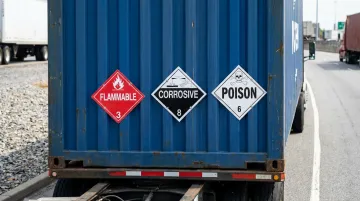
The Department of Transportation (DOT) mandates the use of placards. Failure to comply with these rules can lead to serious consequences, including civil penalties that can exceed $102,000 per violation, according to federal regulations.
The Starting Point: Who is Responsible for Applying Placards?
Understanding who applies hazmat placards is the first step. This responsibility is shared between the shipper and the carrier.
The Shipper's Role
According to federal regulation 49 CFR §172.506, the shipper—the company offering the hazardous material for transport—is responsible for providing the motor carrier with the required placards. This means the company sending the goods must determine the correct placards for the load and give them to the truck driver.
The Carrier's Role
The motor carrier and its driver are then responsible for ensuring those placards are correctly and securely affixed to all four sides of the vehicle or container before it moves. The driver has the final responsibility not to move the vehicle unless it is properly placarded for the materials on board.
The Main Event: Who Must Remove Placards from Empty Containers?
The source of confusion is often that the regulations don't name a single party like "the consignee" or "the carrier" as being responsible for removal. Instead, the rules focus on a core principle: you cannot display a placard for a hazard that isn't there.
49 CFR §172.502(a)(1) states that a placard cannot be displayed unless it represents a hazard currently present in the transport vehicle. Driving a truck with "Flammable" placards when the container is empty is a violation.
So, who gets fined if an empty, placarded container is on the road?
The "Re-Offeror" is Responsible
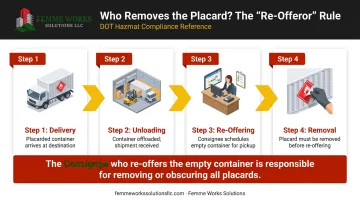
The key to solving this puzzle comes from a PHMSA Letter of Interpretation (05-0050), which clarifies the rules. The responsibility falls on the person or company that "re-offers" the now-empty container for transportation.
Think of it this way: the empty container is starting a new journey. The entity arranging that new journey becomes the "shipper" for this leg of the trip. As the new shipper, they are responsible for ensuring the container is compliant, which includes removing any old placards that no longer apply.
It’s also important to know when the placards can be removed. OSHA rule 29 CFR 1910.1201 states that placards must remain on a container until the hazardous material is "sufficiently removed to prevent any potential hazards." In short, the container must be fully unloaded and cleaned of any dangerous residue before the placards come off.
Clarifying Roles: Shipper vs. Carrier vs. Consignee Responsibilities
The "re-offeror" rule is logical, but how does it apply in the real world? Let's look at a few common scenarios.
Scenario 1: The Consignee Arranges the Return
A manufacturing plant (the consignee) receives a container of hazardous chemicals. After their team unloads the product, the plant manager contacts a trucking company to pick up the empty container and return it to the port.
- Who's responsible? The manufacturing plant is the "re-offeror." Because they are offering the empty container for transport, they must remove the old placards before the truck arrives.
Scenario 2: The Original Shipper Manages the Round Trip
A chemical company (the original shipper) arranges for a truck to deliver a full container to a customer and immediately return the empty container as part of the same job.
- Who's responsible? This is trickier. While the original shipper is technically the re-offeror for the return, the customer (consignee) has physical control. Best practice is a contractual agreement that assigns placard removal duties to the consignee.
Scenario 3: The Carrier Drops and Switches Containers
A carrier drops a full, placarded container at a customer's facility. As part of the same visit, the driver picks up a different container that was emptied the previous week.
- Who's responsible? The facility must remove placards from the empty container before offering it to the carrier. The carrier is then responsible for verifying the container is correctly placarded (or not placarded) before transport.
Best Practices for Smooth, Compliant Hazmat Transport
Disputes over placard removal waste time and create risk. The best way to avoid them is to be proactive and clear about responsibilities from the start.
- Clarify responsibility in all contracts. Your shipping agreements and purchase orders should explicitly state who must remove placards at the delivery destination to eliminate ambiguity.
- Communicate expectations before arrival. Shippers should confirm placard removal duties with the consignee beforehand. Drivers must also be trained to check that placards are gone before accepting an empty container.
- Train your team on compliance. Ensure your warehouse staff, managers, and drivers understand the "re-offeror" rule and their specific duties. A knowledgeable team is the best defense against violations.
For projects involving hazardous waste removal, partnering with a certified expert can prevent these compliance issues. A full-service environmental remediation partner like Femme Works Solutions manages the entire process, from on-site abatement to final disposal.
We handle all logistics, including proper placarding for transport and coordinating its removal. This allows your team to focus on its core business without worrying about compliance risks.
Frequently Asked Questions
Whose responsibility is it to remove hazmat placards?
The person or company that "re-offers" the empty container for its next journey is responsible. This is usually the party that unloads the container and arranges for a carrier to pick it up.
Who is responsible for placarding for hazardous materials?
It's a shared responsibility. The shipper must provide the correct placards to the carrier. The carrier (and its driver) is then responsible for affixing them to the vehicle properly before starting transport.
Who enforces hazmat regulations?
In the U.S., enforcement is handled by several federal agencies. The Department of Transportation (DOT) sets the primary rules, the FMCSA enforces them for highway transport, and OSHA regulates worker safety and hazard communication.