For property owners, managers, and contractors in Massachusetts and New Hampshire, understanding your legal obligations is essential to protect building occupants, workers, and your bottom line. This guide breaks down what a risk assessment is, why it's so important, the step-by-step process, and how to use the results to make smart, safe decisions.
Key Takeaways
- A risk assessment identifies hazardous materials (asbestos, lead, PCBs), evaluates their condition, and gauges the potential for human exposure.
- Federal (EPA, OSHA) and state (MassDEP, NHDES) regulations legally require it to prevent health risks and environmental contamination.
- The process involves a site survey, sample collection, lab analysis, risk scoring, and a final report with a management plan.
- The property owner is ultimately responsible for ensuring the assessment is performed and acted upon.
- Skipping an assessment can lead to severe health issues, project shutdowns, massive fines, and serious legal liability.
What Is an Asbestos & Hazardous Materials Risk Assessment?
A hazardous materials risk assessment is a systematic evaluation to identify the location, type, and condition of dangerous substances within a property. Its primary goal is to create a clear, prioritized plan for managing these materials safely and effectively.
While often confused with a basic asbestos survey, a risk assessment provides a much deeper analysis. A basic survey focuses on identifying the presence and location of Asbestos-Containing Materials (ACMs).
In contrast, a risk assessment evaluates the likelihood of harm. It analyzes the material's condition, accessibility, and potential for disturbance to create an actionable management plan, not just a list of materials.
Why Risk Assessments Are a Non-Negotiable Step for Property Owners
Conducting a professional risk assessment isn't optional—it's a foundational requirement for legal, ethical, and financial reasons.
Ensuring Legal and Regulatory Compliance
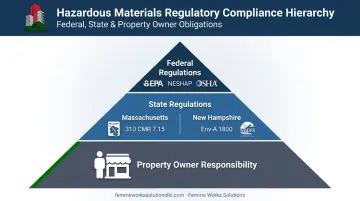
Federal, state, and local laws are crystal clear. Regulations from the EPA (under the National Emission Standards for Hazardous Air Pollutants, or NESHAP) and OSHA mandate that building owners must identify the presence, location, and quantity of hazardous materials before any work that could disturb them.
In our region, this is reinforced by state-specific rules:
- In Massachusetts: MassDEP regulation 310 CMR 7.15 requires a Commonwealth-certified asbestos inspector to perform a survey before any demolition or renovation begins.
- In New Hampshire: NHDES regulation Env-A 1800 requires a certified inspector to conduct an inspection before work starts.
The person or entity legally responsible for the property—often called the "Duty Holder"—has a legal obligation to manage these risks. Failure to comply isn't just a paperwork error; it's a violation of the law.
Protecting Human Health and Safety
These materials pose severe, well-documented health risks. Inhaling microscopic asbestos fibers can lead to devastating diseases like mesothelioma, asbestosis, and lung cancer, often decades after exposure. According to the American Cancer Society, the time between first asbestos exposure and a mesothelioma diagnosis is usually 30 years or more.
Other materials pose immediate threats:
- Lead Dust: Created when lead-based paint is sanded or scraped, it can cause serious neurological damage, especially in children.
- Mercury: Can be released from old thermostats and switches, posing a risk to the nervous system.
- PCBs: Found in old caulking and light ballasts, these are linked to cancer and other health problems.
These risks extend beyond your immediate family or tenants. They endanger contractors, maintenance staff, and even the surrounding community if materials are not handled properly.
Avoiding Financial and Project Disasters
Discovering hazardous materials mid-project is a nightmare scenario. It triggers an immediate work stoppage, derailing your timeline and blowing up your budget with costly emergency remediation.
But the planned costs are nothing compared to the penalties. Failing to conduct a proper assessment can result in staggering fines from regulatory bodies. According to OSHA, a willful or repeated violation can lead to penalties of $165,514 per violation.
These fines, combined with project delays and potential lawsuits, can be financially ruinous. A proactive assessment is a small investment that prevents a potential catastrophe.
How a Professional Risk Assessment Works: A Step-by-Step Guide
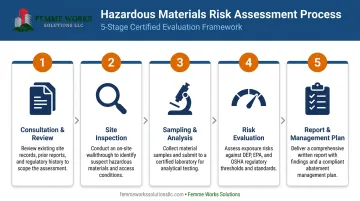
To be legally valid and compliant with regulations from bodies like the EPA and OSHA, a risk assessment must be conducted by a licensed professional. At Femme Works Solutions, our certified team follows a methodical process to ensure your property is safe.
Initial Consultation and Documentation Review The process begins with a conversation. The assessor gathers key information about your property, including its age, construction blueprints, renovation history, and any previous surveys. This background information helps them create a targeted inspection plan.
Comprehensive Site Inspection Next, the certified inspector conducts a thorough visual examination of the property. They methodically move through every accessible area, looking for suspected hazardous materials in common hiding spots like insulation, tiles, paint, caulking, and roofing.
Material Sampling and Laboratory Analysis When a suspected material is found, a certified technician carefully takes a small physical sample. They follow strict OSHA and EPA protocols to prevent releasing any dangerous fibers or dust. These samples are then sent to an accredited laboratory for analysis, often using methods like Polarized Light Microscopy (PLM) to definitively identify asbestos.
Risk Evaluation and Scoring Once the lab results are in, each identified material is given a risk score. This score isn't just about presence; it's about potential danger. Assessors evaluate several factors:
- Condition: Is the material friable (easily crumbled) or non-friable (solid)?
- Location: Is it in a high-traffic area or sealed behind a wall?
- Accessibility: Can it be easily damaged or disturbed?
- Likelihood of Disturbance: How probable is it that planned activities will impact the material?
Final Report and Management Plan Finally, the assessor delivers a comprehensive report. This document includes a detailed inventory of all hazardous materials, their locations marked on floor plans, lab results, risk scores, and clear recommendations. Most importantly, it provides a formal Asbestos Management Plan outlining the procedures for monitoring, handling, encapsulating, or safely removing the identified materials.
Common Hazardous Materials Uncovered in Assessments
While asbestos is the most well-known, assessments often uncover a range of other regulated materials, especially in older buildings.
Asbestos
This mineral fiber was a popular building material for decades due to its heat resistance and durability. It can be found in:
- Pipe and boiler insulation
- Vinyl floor tiles and the mastic used to glue them down
- "Popcorn" ceilings and textured paints
- Roofing shingles and siding
- Vermiculite attic insulation
Lead-Based Paint
Lead-based paint is a major concern in buildings constructed before 1978. According to the EPA, approximately 75% of US homes built before that year still contain some lead-based paint.
When this paint peels, is sanded, or disturbed during renovation, it creates toxic lead dust that is dangerous to inhale or ingest.
Other Hazardous Materials
Assessors also look for other substances, including:
- Polychlorinated Biphenyls (PCBs) in fluorescent light ballasts and building caulking from the 1950s to 1970s.
- Mercury present in old thermostats, pressure gauges, and fluorescent lamps.
- Mold, as significant growth can pose health risks and is often identified during a comprehensive assessment.
Partnering with Experts for a Safe and Compliant Project
A thorough risk assessment is the foundation of any safe, compliant, and successful construction or renovation project. Understanding this process empowers property owners to make responsible decisions that protect both people and their long-term investment.
For property owners and contractors in Massachusetts and New Hampshire, navigating these complex regulations requires a trusted partner. A certified firm ensures your project is fully compliant with all EPA, OSHA, and state-specific rules.
Femme Works Solutions is the partner you can trust. We provide:
- Over 15 years of experience in hazardous material removal
- Transparent communication and an unwavering commitment to safety
- Certified Woman/Minority-Owned Business (WBE/MBE) status
- Proud partnership with the Mass Save program
Frequently Asked Questions
What is the difference between an asbestos survey and a risk assessment?
A survey identifies what hazardous materials are present and where they are located. A risk assessment goes further by evaluating the level of danger each material poses and creating a plan for what to do about it.
How much does a hazardous material risk assessment cost?
The cost varies based on the building's size, age, and complexity. For a precise figure, it's always best to get a detailed quote from a certified professional.
Do I need a risk assessment for a small renovation project?
Yes. Any project that might disturb building materials—like drilling, cutting, or demolition—legally requires an assessment to ensure those materials are not hazardous before work begins.
What happens if asbestos is found during the assessment?
Your report will outline a management plan. This could mean leaving the material undisturbed if stable, encapsulating it, or scheduling professional removal with a licensed abatement contractor.
How often should my property's asbestos risk assessment be reviewed?
Your asbestos register and management plan should be reviewed at least annually, or whenever there's a change in building use, to ensure the information remains current and accurate.
Can I perform a hazardous material risk assessment myself?
No. Due to the serious health risks and strict legal requirements, all assessments, and especially material sampling, must be performed by a licensed and accredited professional.