This is where negative air pressure comes in. It's the non-negotiable, industry-required engineering control that ensures airborne fibers stay locked within the work zone. This guide breaks down what negative pressure is, how the process works, the equipment involved, and why this complex task must be handled by certified professionals.
TL;DR: Key Takeaways on Negative Air Pressure
- Containment is Key: Negative air pressure creates a vacuum-like effect, ensuring air flows into the sealed work area, not out, trapping asbestos fibers.
- It's Legally Required: Federal agencies like OSHA and the EPA, along with state bodies in Massachusetts and New Hampshire, mandate negative pressure for asbestos abatement.
- Specialized Equipment is a Must: The process relies on professional-grade Negative Air Machines (NAMs) with true HEPA filters that capture 99.97% of microscopic particles.
- Certified Professionals Only: Improper setup can lead to widespread contamination. Always hire a certified and licensed professional like Femme Works Solutions who follows EPA, OSHA, and DEP requirements.
Understanding Negative Pressure: The Gold Standard for Asbestos Safety
Negative air pressure is a technique where the air pressure inside a sealed work area is kept lower than the air pressure outside. Think of it like a controlled vacuum. This pressure difference ensures that any potential air leaks flow into the containment zone, preventing hazardous asbestos fibers from escaping into the rest of the building.
The primary goal is to trap and contain airborne asbestos fibers released during removal activities. By pulling air through a series of high-efficiency filters and exhausting it safely outside, the system protects building occupants, workers, and the surrounding environment from contamination.
The Health & Legal Imperative
The health risks associated with inhaling asbestos fibers are severe and well-documented. Exposure can lead to debilitating diseases like mesothelioma, asbestosis, and lung cancer, which often take decades to develop. According to the World Health Organization, occupational asbestos exposure is responsible for over 200,000 deaths globally every year. Without proper controls, these tiny fibers can remain suspended in the air for a long time.
Because of these dangers, using negative pressure systems isn't just a best practice—it's a legal requirement. Federal agencies like the Occupational Safety and Health Administration (OSHA) and the Environmental Protection Agency (EPA) have strict regulations for asbestos abatement, with states like Massachusetts and New Hampshire adding their own specific rules.
Failure to comply brings serious consequences. The Massachusetts Department of Environmental Protection (MassDEP), for instance, recently fined one company $43,500 for asbestos violations involving untrained personnel and improper work practices. This is why hiring a certified contractor who follows the law is non-negotiable.
The Negative Pressure Abatement Process: A Step-by-Step Breakdown
Creating a safe and effective negative pressure environment is a meticulous, multi-step process that requires precision and expertise.
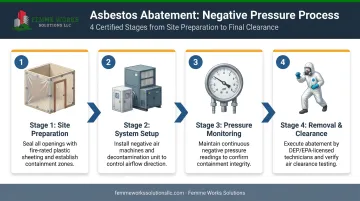
Step 1: Site Preparation and Containment Construction
Before any asbestos-containing material is disturbed, the work area must be completely isolated. This involves:
- Shutting down and sealing all HVAC vents and systems to prevent cross-contamination.
- Removing all movable items (furniture, equipment, decor) from the area.
- Covering any immovable objects with thick plastic sheeting.
- Constructing an airtight containment zone using multiple layers of 6-mil polyethylene sheeting on walls, floors, and ceilings. Every seam is sealed, and all penetrations like outlets, light fixtures, and pipes are completely covered.
Step 2: Setting Up the Decontamination Unit and Negative Air System
A three-stage decontamination unit is built to create an airlock, allowing workers to enter and exit safely without spreading fibers. This unit consists of:
- Equipment Room: Where workers store contaminated tools and outer protective gear.
- Shower Room: A mandatory shower area to remove all traces of asbestos from their bodies.
- Clean Room: A transition space where workers can put on clean clothes before exiting.
Next, one or more Negative Air Machines (NAMs) are strategically placed within the containment. These powerful units are vented to the outside of the building, constantly pulling air out of the work area to create the necessary pressure difference.
Step 3: Achieving and Monitoring Negative Pressure
Once the NAMs are turned on, the system is activated. The industry standard, mandated by OSHA for Class I asbestos operations, is to achieve a pressure differential of -0.02 inches of water column (" WC).
This pressure is continuously measured with a device called a manometer to ensure it remains stable throughout the project.
Professionals also conduct smoke tests to verify the seal is working correctly. During a smoke test, they release a small amount of harmless smoke near the plastic sheeting to visually confirm that air is flowing into the containment.
Step 4: Removal, Decontamination, and Clearance
Only after stable negative pressure is verified does the physical removal of asbestos begin. Technicians use methods like wetting the materials to minimize the release of fibers into the air.
After removal, the process isn't over. The final decontamination and clearance phase includes several critical actions:
- Surface Cleaning: All surfaces are meticulously cleaned using HEPA-filtered vacuums.
- Waste Disposal: Asbestos waste is securely double-bagged and sealed for proper removal.
- Air Filtration: The NAMs continue running to filter any remaining airborne fibers.
- Clearance Testing: An independent, third-party professional conducts a final air test to certify the area is safe for reoccupation.
The Essential Toolkit: Equipment Used to Create and Monitor Negative Pressure
Maintaining a safe negative pressure environment requires professional-grade equipment. This isn't something you can replicate with household tools.
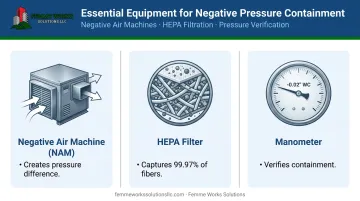
- Negative Air Machines (NAMs): These powerful air filtration devices act as the system's engine. They pull large volumes of air from the containment area to create the pressure differential.
- HEPA Filters: These legally required filters capture 99.97% of particles down to 0.3 microns. This crucial step traps dangerous asbestos fibers and ensures all exhausted air is clean and safe.
- Manometers: These sensitive gauges provide continuous, real-time pressure readings. Technicians use them to verify the containment area stays within the required -0.02" WC safety range.
Staying Compliant: Key Regulations for Asbestos Removal in MA & NH
Staying Compliant: Key Regulations for Asbestos Removal in MA & NH
Navigating asbestos regulations is complex. At the federal level, OSHA focuses on protecting worker safety, while the EPA sets standards to protect public health and the environment.
However, states often have their own, sometimes stricter, rules.
- In Massachusetts, the Department of Environmental Protection (MassDEP) regulates asbestos abatement projects, requiring specific notifications and work practices.
- In New Hampshire, the Department of Environmental Services (NH DES) manages asbestos requirements for renovation and demolition, including licensing and project notifications.
A certified contractor must be an expert in all of these regulations. The team at Femme Works Solutions is fully licensed and insured to perform asbestos abatement in both Massachusetts and New Hampshire.
Our team stays current on all federal, state, and local laws to ensure every project is completed in full compliance, protecting our clients from liability.
Don’t Risk It: Why Professional Negative Pressure Containment is Crucial
Creating and maintaining an effective negative pressure containment is a technical skill that demands specialized equipment, deep knowledge of physics and airflow, and constant monitoring. It must always be performed by a licensed certified professional.
The risks of getting it wrong are severe:
- Widespread Contamination: A failed or improperly built containment can release asbestos fibers throughout your entire property, turning a localized problem into a building-wide disaster.
- Health Dangers: You could endanger the health of your family, employees, or tenants, leading to long-term health consequences.
- Legal & Financial Liability: Failure to follow regulations can result in massive fines, legal action, and the need to pay for a second, more expensive remediation.
With over 15 years of experience, Femme Works Solutions is the trusted expert for safe asbestos removal in Massachusetts and New Hampshire. Our certified team uses state-of-the-art equipment and follows strict regulatory protocols to ensure every project is performed with the highest level of safety and compliance.
If you suspect you have asbestos in your property, don't wait. Contact Femme Works Solutions today for a professional consultation.
Frequently Asked Questions
What is negative pressure for asbestos removal?
It's a containment method that keeps air pressure inside a sealed work area lower than the outside. This pressure difference prevents airborne asbestos fibers from escaping by pulling them into a HEPA filtration system.
How long can asbestos stay in the air after removal?
Without proper containment, asbestos fibers can remain airborne for days. Negative air systems run continuously to capture these particles until professional air testing confirms the area is safe.
How is negative pressure monitored during an asbestos abatement project?
It is monitored continuously with a device called a manometer, which measures the pressure difference. Professionals also perform visual smoke tests to confirm that air is flowing into the containment, not out of it.
Can I use a household air purifier instead of a negative air machine?
No. Household purifiers cannot create negative pressure, and their filters are not rated for asbestos. Using one creates a false sense of security and risks spreading contamination.
What happens if negative pressure fails during the removal process?
If negative pressure fails, all work stops immediately. Professionals find and fix the cause, whether it's an equipment failure or a containment breach. Work only resumes after pressure is restored and verified.
Is the area safe to enter immediately after the negative air machines are turned off?
No, the area is only safe after passing a final air clearance test. This is performed by an independent professional to verify the airborne fiber count is below the legal safety limit.