Understanding the complexities of industrial asbestos removal is critical for preventing catastrophic fiber release during maintenance, renovations, or demolition. This guide provides a clear overview of the abatement process, the strict federal and state laws that govern it, and the non-negotiable protocols for safe disposal, ensuring you can protect your people and your facility.
TL;DR: The Essentials of Industrial Asbestos Abatement
TL;DR: The Essentials of Industrial Asbestos Abatement
- Industrial abatement is a regulated process to safely remove asbestos from commercial facilities.
- The process includes site assessment, containment, professional removal, and secure disposal.
- Strict compliance with federal (OSHA, EPA) and state laws (like MassDEP) is mandatory.
- Hiring a certified contractor is crucial to avoid significant health risks and legal liability.
What is Industrial Asbestos Abatement?
Industrial asbestos abatement is the systematic process for identifying, containing, removing, and disposing of asbestos-containing materials (ACMs) from industrial facilities, plants, and manufacturing sites. Unlike residential projects, industrial abatement deals with a larger scale, greater complexity, and unique materials.
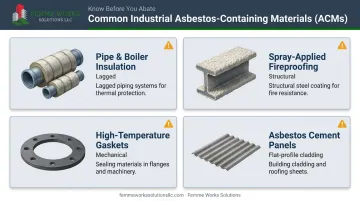
Common ACMs found in industrial settings include:
- Pipe and boiler insulation (lagging)
- High-temperature gaskets
- Spray-applied fireproofing
- Asbestos cement panels and pipes
- Electrical insulation
The primary goal is to prevent the release of airborne asbestos fibers—proven carcinogens linked to diseases like mesothelioma and asbestosis. Professionals use two main abatement methods, though one is far more common for industrial sites.
- Removal: The complete physical extraction of ACMs. As the most permanent solution, this is the required method for facilities undergoing significant renovation, equipment replacement, or demolition.
- Encapsulation: Sealing the asbestos material with a durable, penetrating coating. This approach is less common in industrial environments where high heat, vibration, and wear could compromise the sealant.
Why Professional Abatement is Critical in Industrial Environments
Attempting to manage or remove asbestos without certified professionals is a recipe for disaster. The risks are severe, impacting health, finances, and operations.
Severe Health Risks
When disturbed, asbestos releases microscopic fibers that can be inhaled deep into the lungs, causing irreversible damage and deadly diseases years or decades later. According to the CDC, exposure to asbestos causes most cases of mesothelioma, with 2,669 new cases reported in the United States in 2022 alone. Failing to control these fibers creates long-term liability for the facility owner and endangers every worker on site.
Legal and Financial Consequences
Regulatory bodies do not take compliance lightly. The EPA and OSHA impose heavy fines and can order complete work stoppages for violations. In May 2024, for example, OSHA proposed $392,002 in penalties against a subcontractor for knowingly exposing employees to asbestos hazards during a demolition project. These penalties, combined with potential lawsuits, can be financially crippling.
Operational Stability
Proper asbestos abatement is crucial for business continuity. A contaminated site can shut down production, delay critical maintenance, and halt expansion projects. Ensuring a facility is properly cleared of asbestos protects not only your personnel but also your capital equipment from contamination, allowing operations to proceed safely and on schedule.
The Step-by-Step Industrial Asbestos Removal Process
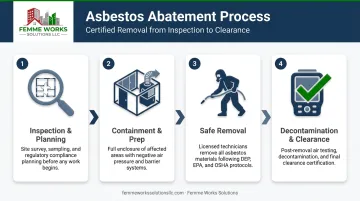
Every industrial asbestos abatement project must follow a strict, methodical sequence to guarantee safety and compliance from start to finish.
Step 1: Site Inspection and Project Planning
The process begins with a comprehensive site inspection by a certified asbestos inspector. They identify all potential asbestos-containing materials (ACMs) and take samples for lab analysis using Polarized Light Microscopy (PLM). This confirms the asbestos type and concentration. Based on these findings, a detailed work plan is created that outlines the project scope, containment strategy, and safety procedures.
Step 2: Work Area Preparation and Containment
Before any removal begins, the work area is completely isolated. This involves:
- Posting warning signs to restrict access.
- Disabling and sealing HVAC systems to prevent cross-contamination.
- Erecting a multi-stage decontamination unit for workers to enter and exit safely.
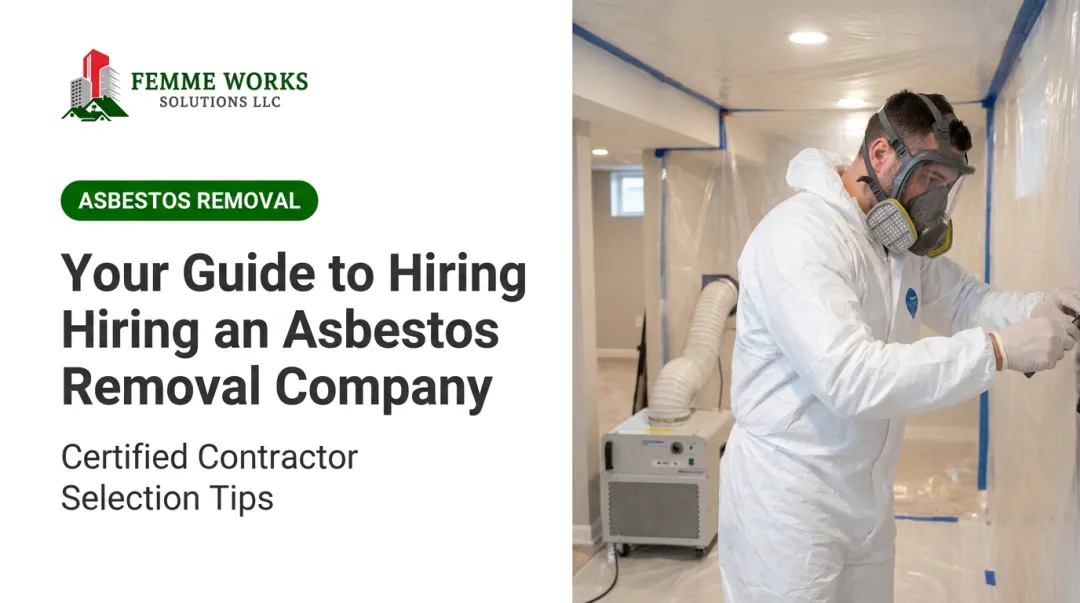
- Sealing the entire work zone with critical barriers made of heavy-duty plastic sheeting.
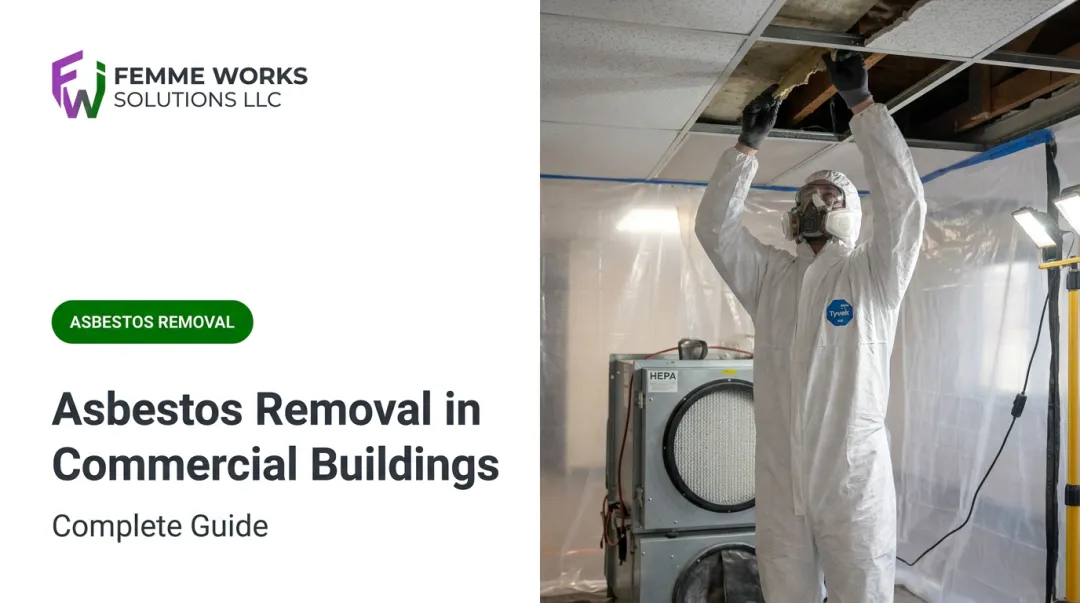
- Installing HEPA-filtered negative air machines to create a vacuum, preventing contaminated air from escaping.
Step 3: Safe Asbestos Removal
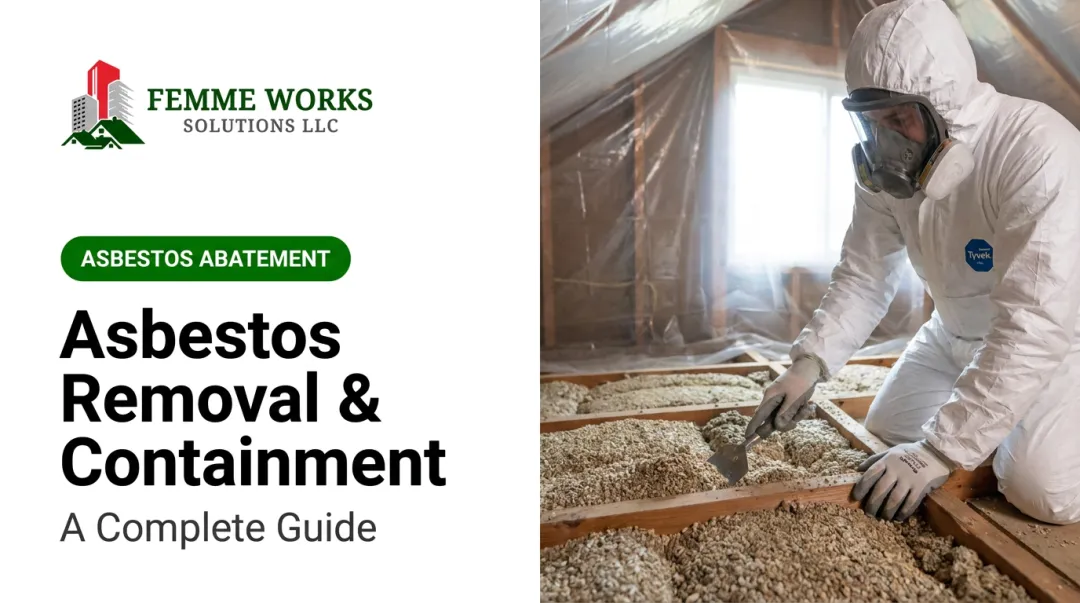
Licensed abatement workers enter the contained area wearing full personal protective equipment (PPE), including full-face respirators and disposable coveralls. Workers use "wet methods" by applying a special wetting agent to the ACMs. This critical step suppresses dust and prevents asbestos fibers from becoming airborne. Any debris is cleaned up immediately with industrial-grade HEPA vacuums.
Step 4: Decontamination and Final Clearance
Once all visible ACMs have been removed and bagged, the entire contained area is meticulously cleaned using wet wiping techniques and HEPA vacuums. An independent third-party industrial hygienist then conducts a final visual inspection to ensure no residue remains.
Finally, an independent hygienist performs aggressive air sampling to test the air quality. The area must pass clearance tests, showing the airborne fiber count is below the legal limit (0.01 fibers per cubic centimeter).
At Femme Works Solutions, following this state-mandated process isn't just about compliance—it's how we guarantee your facility is safe for re-entry.
Understanding the Laws and Disposal Requirements for Industrial Asbestos
Navigating federal, state, and local regulations is a critical aspect of industrial asbestos abatement.
Key Federal Regulations
Two main federal agencies set the standards for asbestos work in the United States.
- OSHA (Occupational Safety and Health Administration): OSHA's regulations, particularly the Asbestos Standard for Construction (29 CFR 1926.1101), focus on worker safety. This standard dictates permissible exposure limits (PELs), PPE requirements, medical surveillance for workers, and mandatory training protocols.
- EPA (Environmental Protection Agency): The EPA's NESHAP (National Emission Standards for Hazardous Air Pollutants) regulations govern asbestos work practices during the renovation and demolition of facilities. The goal of NESHAP is to protect the public by preventing the release of asbestos fibers into the outside environment.
State and Local Compliance
Many states and municipalities have their own asbestos regulations that are often stricter than federal laws. For instance, in Massachusetts, all abatement work must comply with the Department of Environmental Protection (MassDEP) regulation 310 CMR 7.15, which has specific notification and work practice requirements.
This is why hiring a local, licensed abatement contractor is so important. A firm like Femme Works Solutions, fully certified and experienced in both Massachusetts and New Hampshire, understands the specific compliance landscape.
They ensure every project adheres to the latest MassDEP and NHDES rules, preventing costly fines and delays.
Proper Asbestos Waste Disposal
Asbestos disposal is as regulated as its removal. The protocol is strict:
- All ACMs must be thoroughly wetted and sealed in double-layered, leak-tight bags or containers.
- Each container must be clearly labeled with asbestos warning labels.
- The waste must be transported in a covered vehicle to a special landfill licensed to accept asbestos.
- A waste shipment record, or manifest, must be completed to track the material from the job site to its final disposal, creating a permanent legal record.
Common Issues and Misconceptions in Industrial Abatement
Mistakes and misunderstandings can lead to dangerous and expensive consequences. Here are a few common pitfalls to avoid.
Assuming non-friable materials are safe. While materials like asbestos floor tiles or cement panels are stable when intact, they are not inherently safe during industrial work.
Processes like cutting, grinding, or drilling can pulverize them, releasing hazardous fibers. They must be handled with the same care as any other asbestos-containing material (ACM).
Failing to maintain proper containment. A breach in containment is a worst-case scenario. If fibers escape the work area, they can contaminate adjacent production lines, offices, or HVAC systems.
This leads to a larger, more complex, and significantly more expensive cleanup, often requiring a full facility shutdown.
Hiring an unqualified contractor. Choosing a contractor based on the lowest bid is a major risk. Unlicensed or uninsured teams may cut corners on containment, worker safety, and proper disposal.
Always verify a contractor’s license, insurance, and training records to avoid failed clearance tests, regulatory fines, and lingering liability.
Frequently Asked Questions
How much does industrial asbestos removal cost?
Costs vary widely depending on the type of ACM, its location and accessibility, the scale of the project, and specific regulatory requirements. Industrial projects are almost always quoted on a per-project basis after a thorough site inspection, not per hour.
How do professionals perform industrial asbestos removal?
Licensed professionals inspect materials, establish negative-pressure containment, and use wet methods for removal. The process concludes with rigorous air clearance testing to ensure the area is safe for re-entry.
Can asbestos be 100% removed during industrial asbestos removal?
The goal is to remove all visible asbestos-containing materials (ACMs). Success is officially measured by meeting the regulatory air clearance level (e.g., below 0.01 f/cc), which confirms the air is safe and the hazard is abated per law.
What is the 3-5-7 rule for asbestos sampling?
This EPA strategy ensures accurate assessment of homogenous, friable materials. It requires 3 samples for areas under 1,000 sq ft, 5 for 1,000-5,000 sq ft, and 7 for areas over 5,000 sq ft.