Failing to manage these materials correctly can lead to hefty fines, stop-work orders, serious worker health issues, and lasting environmental damage. This guide provides a complete, step-by-step framework for creating and implementing a compliant hazardous waste management plan on any construction site, ensuring your project runs safely and responsibly from start to finish.
Key Takeaways
- Managing construction waste is a multi-step process governed by strict EPA and OSHA rules.
- Common hazards include asbestos, lead paint, contaminated soil, and chemical solvents.
- Core steps include planning, segregation, storage, transport, and documented disposal.
- Non-compliance leads to severe penalties, project shutdowns, and major health risks.
- Partnering with certified experts is essential for handling high-risk materials and ensuring compliance.
What Is Hazardous Waste Management on Construction Sites?
Hazardous waste management on a construction site is the formal set of procedures used to safely handle materials that pose a threat to human health or the environment. It covers the entire lifecycle of the waste, from the moment it's generated on-site ("cradle") to its final, documented disposal ("grave").
The primary goal is to prevent the release of harmful substances into the air, soil, and water. This protects workers from dangerous exposure and ensures the construction company meets all local, state (like MassDEP in Massachusetts), and federal (EPA, OSHA) legal requirements.
Ultimately, it's a non-negotiable part of modern, responsible construction.
Why Proper Waste Management is Critical on Construction Sites
Ignoring hazardous waste protocols is one of the fastest ways to derail a project. The consequences are not just financial; they impact worker safety, project timelines, and your company's reputation.
Legal and Financial Consequences
The primary federal law governing hazardous waste is the Resource Conservation and Recovery Act (RCRA). Under this act, the construction company that generates the waste is liable for it forever.
Non-compliance can be incredibly expensive. As of 2025, a general RCRA violation carries a maximum civil penalty of $93,058 per violation, per day. These fines can quickly escalate into hundreds of thousands of dollars for ongoing issues.
Health and Safety Risks
Beyond the financial penalties, many materials found on job sites pose serious health threats. Exposure to these substances can cause severe, long-term health problems for your crew and the public.
- Asbestos fibers are known carcinogens that cause mesothelioma and lung cancer.
- Lead dust is a potent neurotoxin that can cause permanent neurological damage.
- Volatile Organic Compounds (VOCs) from solvents and paints can cause everything from headaches and nausea to liver, kidney, and central nervous system damage.
Project Delays and Reputational Damage
Regulatory violations don't just impact finances and safety—they can trigger an immediate stop-work order from the EPA or OSHA, shutting down a job site for weeks or even months. This leads to missed deadlines, contractual penalties, and frustrated clients. The damage to your company's reputation can be even more costly, making it difficult to win future bids or attract top talent.
The 6-Step Hazardous Waste Management Process
A successful hazardous waste program follows a clear, end-to-end workflow. Following these six steps ensures nothing is missed and your project remains compliant.
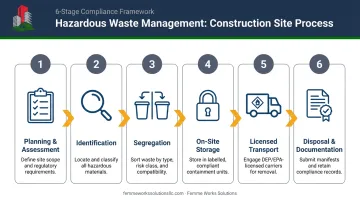
Step 1: Planning and Site Assessment
Before any work begins, conduct a thorough Environmental Hazard Assessment. This is especially critical for demolition or renovation projects in older buildings. Based on this assessment, create a written Waste Management Plan that:
- Identifies all potential hazardous materials expected on site.
- Estimates the volumes of each type of waste.
- Designates specific, secure storage areas on a site map.
- Assigns responsibility for managing the waste program.
Step 2: Identification and Characterization
You must correctly identify any hazardous materials. This involves reviewing Safety Data Sheets (SDS) for all new chemicals brought on-site and testing existing materials. Common tests include paint chip analysis for lead or building material surveys for asbestos. Under OSHA's Hazard Communication Standard, all workers must be trained on the hazards of the chemicals they work with.
Step 3: Safe Segregation
Hazardous waste must never be mixed with non-hazardous construction debris. Mixing waste streams can turn an entire dumpster of standard debris into a costly hazardous waste problem. Use separate, clearly labeled containers for different types of waste. For example, use one sealed drum for oily rags, a different one for spent solvents, and specially marked, sealed bags for asbestos-containing materials (ACM).
Step 4: Compliant On-Site Storage
Your temporary on-site storage area must be secure and compliant. Key requirements include:
- Security: The area should be locked or monitored to prevent unauthorized access.
- Protection: It must be protected from weather, such as rain or extreme heat.
- Containment: The area should have secondary containment (like a spill pallet) to catch any leaks.
- Labeling: All containers must be kept closed, be in good condition, and be clearly labeled with the words "Hazardous Waste," a description of the contents, and the date accumulation began.
Step 5: Licensed Transport
Once ready for removal, the waste can only be moved by a licensed hazardous waste carrier with an official EPA ID number. The entire shipment is tracked using the Uniform Hazardous Waste Manifest system, a legal document that follows the waste from your site to its final destination, ensuring a complete chain of custody.
Step 6: Proper Disposal and Documentation
Finally, the waste must be transported to a permitted Treatment, Storage, and Disposal Facility (TSDF). Your responsibility doesn't end when the truck leaves the site. You must obtain and keep copies of the signed manifests for at least three years to prove the waste was disposed of correctly.
Partnering with a certified specialist is crucial for this final step. A professional service like Femme Works Solutions can manage the entire documentation process for you, from manifest tracking to final disposal certificates, ensuring your "cradle-to-grave" liability is covered.
Common Hazardous Wastes on Construction Sites
Knowing what to look for is the first step in proper management. Here are some of the most common hazardous materials found on construction and demolition sites.
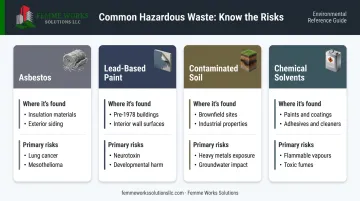
Asbestos Containing Materials (ACM)
- Where it's found: Insulation, vinyl flooring, roofing, siding, and pipe wrap in buildings constructed before the 1980s.
- Primary risks: Inhaling microscopic asbestos fibers can cause incurable diseases like asbestosis, lung cancer, and mesothelioma.
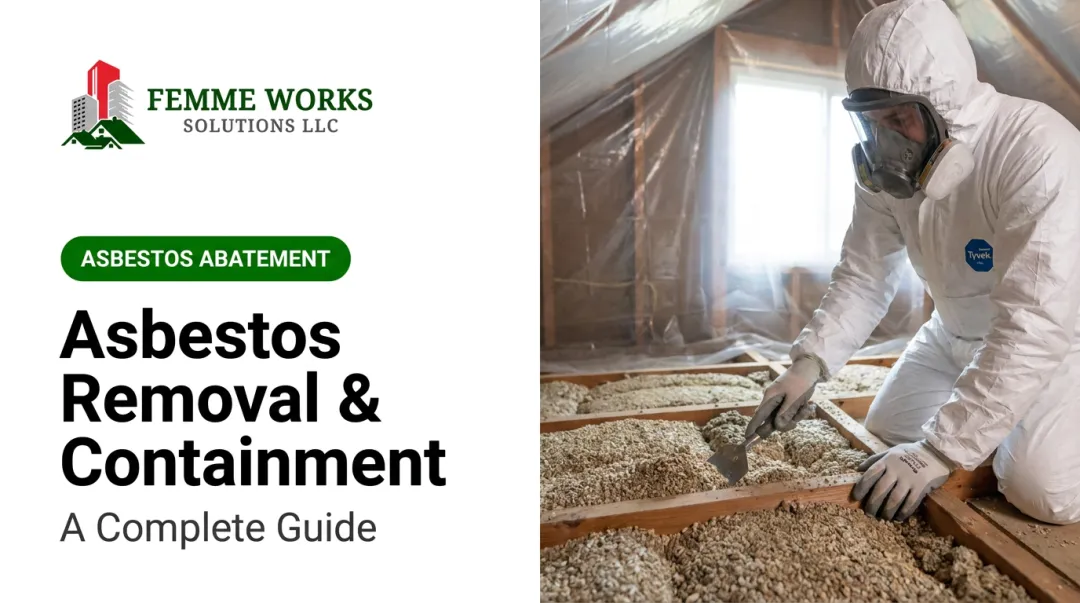
- Handling Note: Asbestos removal is highly regulated by the EPA and OSHA. It must only be performed by a state-licensed and certified abatement contractor. These professionals use state-of-the-art equipment, including HEPA vacuums and negative air machines, to safely contain and remove all fibers.
Lead-Based Paint
- Where it's found: Common in homes, schools, and commercial buildings built before 1978.
- Primary risks: Lead dust created during demolition or renovation is a powerful neurotoxin that is especially dangerous to children.
- Handling Note: Any work that disturbs lead-based paint must follow the EPA's Renovation, Repair, and Painting (RRP) Rule, which requires lead-safe work practices performed by certified professionals.
Contaminated Soil
- Where it's found: Often on "brownfield" sites, former industrial areas, or properties with old underground storage tanks. Soil can contain heavy metals, petroleum byproducts, solvents, or pesticides.
- Primary risks: Direct contact can cause skin irritation or poisoning. Contaminants can also leach into groundwater or become airborne dust.
- Handling Note: Soil must be tested and characterized by a lab to determine the specific contaminants and the appropriate method for disposal or on-site treatment.
Chemical and Solvent Wastes
- Where it's found: Includes leftover paints, thinners, adhesives, sealants, curing compounds, and cleaning agents.
- Primary risks: Many of these liquids are flammable ("ignitable") or release toxic fumes (VOCs).
- Handling Note: These must be collected in sealed, appropriate containers and can never be poured down a drain or onto the ground. They are classified as ignitable or toxic hazardous waste.
Universal Waste
- Where it's found: This is a special category of hazardous waste with simpler regulations. It includes items like fluorescent bulbs (contain mercury), batteries, and some electronic equipment (e-waste).
- Primary risks: Heavy metals like mercury, lead, and cadmium can leach into the environment if sent to a landfill.
- Handling Note: While rules are less strict than for other hazardous wastes, universal waste still cannot be thrown in the regular trash and requires specific recycling or disposal routes.
Best Practices and Common Pitfalls to Avoid
Best Practice: Comprehensive Employee Training
All on-site personnel should receive training appropriate to their role. This can range from basic hazard awareness for all workers to the comprehensive 40-hour HAZWOPER (Hazardous Waste Operations and Emergency Response) training for team members who directly handle, store, or manage hazardous waste. A well-trained team is your first line of defense.
Common Pitfall: Misclassifying Waste
One of the costliest mistakes is assuming all construction debris is non-hazardous. Failing to properly identify materials before demolition can lead to improper disposal and significant legal risks.
For example, peeling paint may contain lead and old insulation could contain asbestos. Mishandling these materials can result in massive fines and cleanup costs. When in doubt, always test.
Best Practice: Prioritize Waste Minimization
The best way to reduce risk is to reduce the amount of hazardous waste you generate in the first place.
- Order materials carefully to avoid excess.
- Use non-hazardous alternatives for sealants, cleaners, or coatings when possible.
- Practice deconstruction instead of demolition to salvage and reuse materials.
Frequently Asked Questions
What is hazardous construction waste?
It's any discarded material from a construction site that is ignitable, corrosive, reactive, or toxic. These materials pose a direct risk to human health or the environment if not managed properly.
What are examples of hazardous waste on site?
Common examples include asbestos-containing insulation, lead-based paint chips, chemical solvents, mercury-containing fluorescent lamps, and soil contaminated with petroleum or heavy metals.
What are the 8 types of waste in construction?
General construction waste is often categorized into concrete, wood, metal, drywall, masonry, asphalt, plastics, and glass. Hazardous materials can be present in any of these, such as lead in painted drywall or asbestos in old insulation.
Who is legally responsible for hazardous waste on a construction site?
Under the EPA's RCRA law, the "generator" of the waste—typically the construction company or property owner—is legally responsible from "cradle-to-grave," even after a hauler takes it away.
What are the penalties for improper hazardous waste disposal?
Penalties are severe and can include civil fines of over $93,000 per violation, per day. In cases of knowing violations, they can escalate to criminal charges, including prison time and significant fines.
Do I need a special license to remove asbestos?
Yes. Federal and state laws mandate that asbestos abatement must only be performed by trained, licensed, and certified professionals to ensure it is handled safely without releasing dangerous fibers.