Commercial asbestos abatement is the process of identifying, removing, repairing, and encapsulating asbestos-containing materials (ACMs) in non-residential buildings. This guide is designed for property managers, building owners, and contractors who need a clear understanding of the process, from initial inspection to final air clearance, ensuring projects in Massachusetts and New Hampshire are handled safely and correctly.
Key Takeaways
- Asbestos abatement in commercial buildings is a highly regulated process to remove or contain hazardous asbestos-containing materials (ACMs).
- It is legally required before any renovation or demolition to protect occupants from serious health risks like asbestosis and mesothelioma.
- The process involves professional inspection, full containment of the work area, safe removal by certified technicians, and proper disposal.
- Key factors include understanding federal and state regulations (like EPA's NESHAP), choosing between removal and in-place management, and hiring a licensed contractor.
What Is Commercial Asbestos Abatement?
Commercial asbestos abatement is a specialized service designed to control exposure to asbestos fibers in workplaces, industrial facilities, and public buildings. It goes beyond simple removal and includes several approved strategies:
- Removal: The complete extraction of ACMs from the building.
- Encapsulation: Sealing the asbestos material with a durable coating that prevents fiber release.
- Enclosure: Building an airtight barrier around the ACM to isolate it from the surrounding environment.
The primary goal is always the same: to eliminate or control the release of asbestos fibers into the air.
This process is far more complex than residential abatement due to stricter regulations, the larger scale of projects, and potential business disruption. It also involves complicated liability issues between landlords, tenants, and employees.
Why Asbestos Removal Is Critical in Commercial Properties
Ignoring asbestos in a commercial building isn't an option. The legal, health, and financial consequences are simply too high. Proactive management and abatement are essential for three key reasons.
1. Legal and Regulatory Compliance
Federal and state laws strictly govern how asbestos is handled in commercial properties. The EPA's National Emission Standards for Hazardous Air Pollutants (NESHAP) is a primary driver, mandating that building owners conduct a thorough asbestos inspection before any demolition or renovation project begins.
These rules are triggered when a project involves at least 260 linear feet of asbestos on pipes or 160 square feet on other components. Additionally, OSHA requires building owners to identify asbestos and notify employees, contractors, and tenants of its presence before any work starts.
2. Significant Health Risks
When asbestos-containing materials (ACMs) are disturbed, they release microscopic fibers that can be inhaled deep into the lungs. This exposure can lead to devastating diseases years or even decades later. The latency period for mesothelioma, a cancer caused almost exclusively by asbestos, can range from 20 to 71 years after initial exposure, according to the CDC. This long delay underscores why preventing exposure today is so critical for protecting the future health of tenants, staff, and contractors.
3. Severe Financial Implications
Failing to comply with asbestos regulations carries steep penalties. For example, the EPA fined an Idaho property owner more than $88,000 in 2023 for violations during a commercial demolition. Beyond EPA and OSHA fines, you also risk civil lawsuits, project shutdowns, property devaluation, and difficulty securing insurance.
How the Commercial Asbestos Abatement Process Works
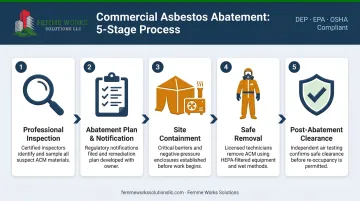
A professional commercial asbestos abatement project follows a strict, multi-step process to ensure safety and compliance from start to finish.
Step 1: Professional Inspection and Testing
The first step is a survey conducted by a licensed asbestos inspector. They visually assess the property to identify materials suspected of containing asbestos. Samples are then carefully collected and sent to an accredited laboratory for analysis to confirm the presence, type, and friability (how easily it crumbles) of any asbestos.
Step 2: Abatement Plan and Regulatory Notification
Once asbestos is confirmed, a detailed, site-specific work plan is created. This plan outlines the scope of work, containment methods, safety protocols, and disposal procedures. Before work begins, the building owner or abatement contractor must notify the appropriate state agencies, such as the Massachusetts Department of Environmental Protection (MassDEP) or the New Hampshire Department of Environmental Services (NHDES), typically at least 10 working days in advance.
Step 3: Site Preparation and Containment
The work area is completely isolated to prevent cross-contamination. This involves:
- Sealing off the area with thick plastic sheeting.
- Shutting down and sealing HVAC vents.
- Posting clear warning signs at all entry points.
- Using negative air pressure machines with HEPA filters to ensure air flows into the contained area, not out of it.
Step 4: Safe Removal and Disposal
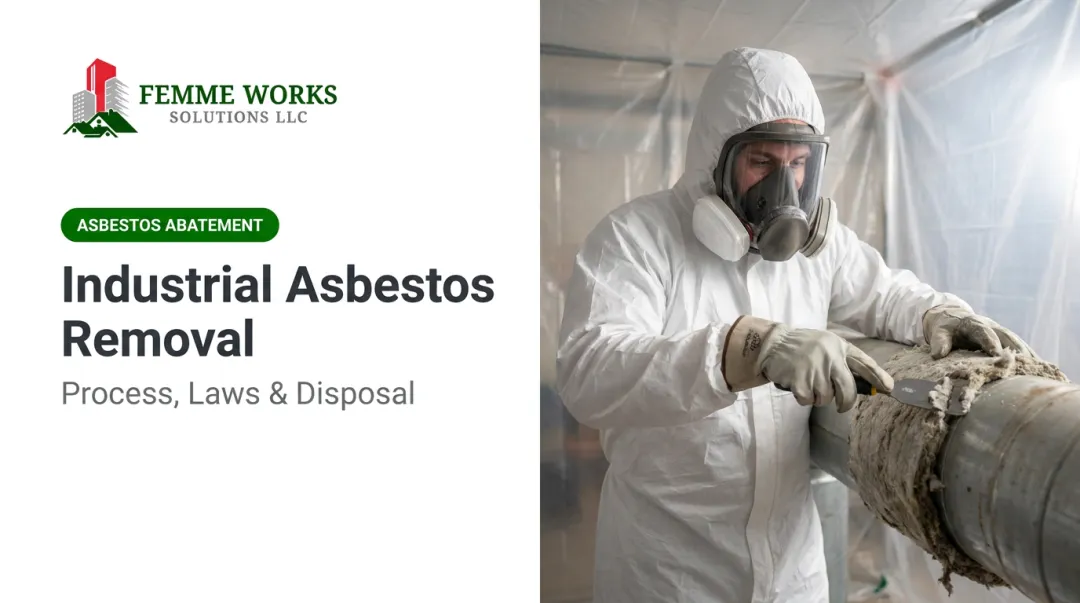
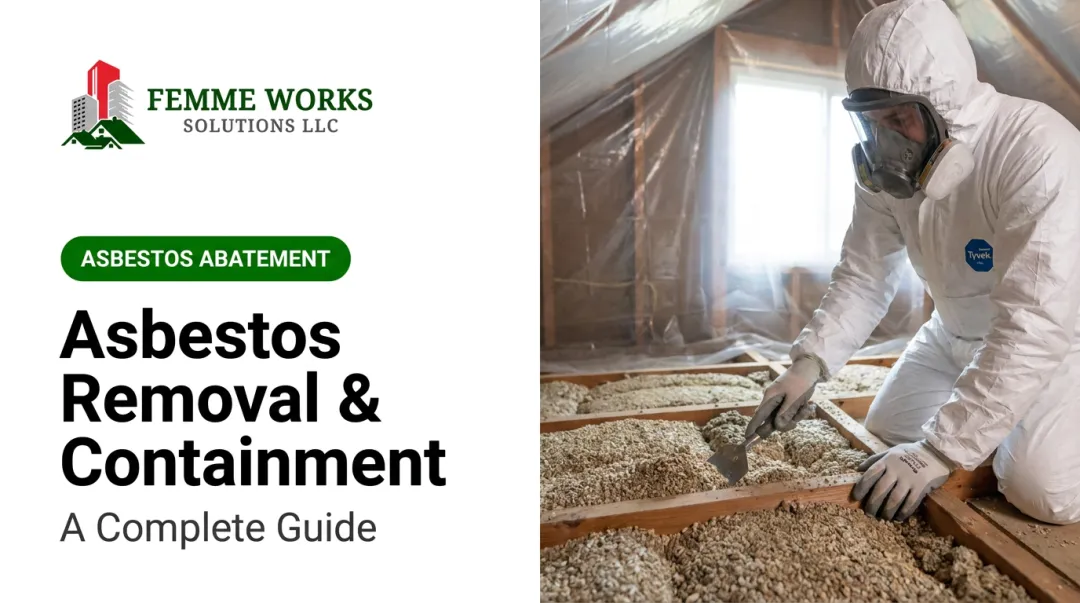
Certified abatement workers enter the contained area wearing full personal protective equipment (PPE), including respirators and disposable suits. They use specialized techniques, such as wetting asbestos-containing materials (ACMs), to minimize the release of airborne fibers.
The removed material is immediately sealed in leak-proof, specially labeled bags and transported by a licensed hauler to a landfill designated for hazardous waste.
Step 5: Post-Abatement Clearance
After removal is complete, a third-party industrial hygienist conducts a final clearance process. This includes a thorough visual inspection to ensure no debris remains, followed by aggressive air sampling.
The air samples are analyzed to confirm the fiber concentration is below the permissible exposure limit, certifying the area is safe for re-occupancy.
Key Factors That Affect Commercial Asbestos Removal
Every commercial abatement project is unique. Several key factors will influence the scope, cost, and legal requirements.
Regulatory Compliance and Liability
While federal EPA and OSHA laws provide a baseline, regulations often become stricter at the state and even city level. The legal responsibility for compliance almost always falls on the property owner.
Even if a lease assigns some duties to a tenant for a specific renovation, the owner is ultimately accountable for ensuring the building is safe and that all work adheres to the law.
Project Cost and Budgeting
The cost of commercial asbestos abatement varies widely. Key factors that influence the final price include:
- Type and amount of ACM: Friable materials like pipe insulation are more complex and costly to remove than non-friable floor tiles.
- Location and accessibility: Asbestos in a crawlspace or high ceiling is harder to access and requires more labor than materials in an open room.
- Abatement method: Full removal is more expensive than encapsulation or enclosure.
Every project needs a custom quote. Factors like material type, quantity, location, and accessibility all affect the scope. Contact Femme Works Solutions for a detailed, no-hidden-fee quote based on your specific property conditions.
Choosing a Qualified Asbestos Abatement Contractor
Hiring the right contractor is the single most important decision a property manager can make. Your contractor must be licensed, insured, and certified specifically for asbestos work in your state.
When vetting a contractor, verify their:
- Licensing and Insurance: Ask for proof of current state licenses and specialized environmental liability and errors and omissions insurance.
- Compliance Record: Check their history with the EPA, OSHA, and state agencies like MassDEP.
- Relevant Experience: Ensure they have a proven track record with commercial projects similar to yours. Femme Works Solutions, for instance, has over 15 years of experience handling abatement in schools, industrial facilities, and municipal buildings across Massachusetts and New Hampshire.
- Detailed Quotes: A professional quote will clearly outline the full scope of work, safety protocols, and costs with no hidden fees.
Abatement vs. Management-in-Place: Making the Right Choice
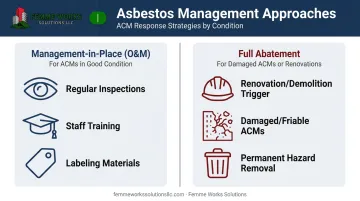
Full removal is not always the only compliant option. For some buildings, an Operations and Maintenance (O&M) program, also known as management-in-place, can be a safe and effective alternative.
An O&M program is a good fit when asbestos-containing materials (ACMs) are in good, non-friable condition and are unlikely to be disturbed. This approach involves:
- Inspecting materials regularly to monitor their condition.
- Training maintenance staff to work safely around ACMs.
- Labeling all identified materials to prevent accidental damage.
- Maintaining detailed records of asbestos locations and management activities.
However, full abatement becomes the only option when certain triggers are present. You must schedule removal if you are planning major renovations or demolition that will disturb the ACMs.
Likewise, if the materials are already damaged, deteriorating, or flaking (friable), immediate abatement is necessary to eliminate the hazard.
Your Partner in Safety and Compliance
Commercial asbestos removal is a complex but manageable process when handled by experienced professionals. Understanding the regulations, your responsibilities as a property owner, and the available management options empowers you to make smart, compliant decisions that protect building occupants and preserve your asset's value.
For property managers in Massachusetts and New Hampshire, navigating these complex regulations requires a local expert you can trust. With over 15 years of experience, Femme Works Solutions is the certified, woman-owned partner dedicated to managing your project safely, efficiently, and correctly from day one.
Frequently Asked Questions
Does insurance cover asbestos removal for commercial buildings?
Standard commercial property insurance typically excludes asbestos removal unless it's required due to a covered event like a fire. Specialized environmental liability policies are usually needed to cover abatement costs.
Can you be in a commercial building while asbestos is being removed?
The direct work area must be fully sealed and unoccupied for safety. Remote parts of the building may remain occupied depending on the layout and HVAC system, but this requires a professional case-by-case assessment.
Can asbestos be completely removed from commercial buildings?
Yes, licensed professionals can remove all identified asbestos-containing materials. Post-abatement air testing is then performed to verify the area is safe and the fiber count is below the legal limit for re-occupancy.
What is the 3-5-7 rule for asbestos sampling?
This AHERA guideline advises taking 3 samples for areas up to 1,000 sq. ft., 5 for 1,000-5,000 sq. ft., and 7 for areas over 5,000 sq. ft. This ensures accurate testing results for different-sized spaces.
What are the legal responsibilities of a commercial landlord for asbestos?
Landlords must inspect for asbestos, notify tenants and employees of its presence, and ensure any removal work complies with all regulations. Their primary responsibility is to provide a safe environment for occupants.
How much does commercial asbestos abatement typically cost?
Every project is different. Cost depends on material type, quantity, accessibility, and scope of work. Contact Femme Works Solutions for a detailed, no-obligation quote based on your specific property.