While asbestos abatement often happens before or during a construction project, it is fundamentally not a typical construction job. It's a highly specialized environmental remediation service, governed by a maze of strict federal and state regulations designed to protect workers, occupants, and the public from a known carcinogen.
This article will break down the critical differences between standard construction and asbestos abatement. We'll explore the unique regulations, safety protocols, and expert training that set this work apart and explain why treating them the same is a risk you can't afford to take.
TL;DR: Asbestos Abatement vs. Construction
- Asbestos abatement is a specialized environmental service, not standard construction, due to severe health risks and strict regulations from OSHA and the EPA.
- Key differences include mandatory containment zones, specialized air monitoring, specific worker certifications, and hazardous waste disposal protocols.
- Treating abatement like a typical construction job can lead to serious legal penalties, project shutdowns, and long-term health liabilities.
- Always hire a licensed and certified asbestos abatement contractor for any project involving the disturbance of asbestos-containing materials.
What Defines a "Typical" Construction Project?
To understand why asbestos abatement is different, we first need to define what a "typical" construction or renovation project looks like. These projects focus on building, altering, or repairing structures using common materials like wood, concrete, drywall, and steel.
The project lifecycle is familiar: planning, permitting, site preparation, building, and cleanup. The primary goal is a structural or aesthetic outcome—a new wall, a repaired roof, or a finished basement.
The regulatory framework for general construction mainly involves:
- Building Codes: Rules that dictate structural integrity, electrical wiring, plumbing, and fire safety.
- Permits: Local approvals needed to begin work.
- General Worker Safety: Standard OSHA rules covering fall protection, electrical safety, and personal protective equipment (PPE) like hard hats and safety glasses.
A general contractor is an expert at managing trades like carpentry and plumbing, scheduling timelines, and ensuring the final product meets building codes.
Their expertise is in building things—not in eliminating microscopic, cancer-causing hazards.
What is Asbestos Abatement? A Specialized Field Defined by Regulation
Unlike a typical construction project, asbestos abatement isn't about building something new—it's about making an existing environment safe. The work involves the identification, removal, encapsulation, or enclosure of asbestos-containing materials (ACMs) with one primary goal: to prevent the release of harmful asbestos fibers into the air.
This work is governed by health and safety agencies like the Environmental Protection Agency (EPA) and the Occupational Safety and Health Administration (OSHA). The foundational rulebook that sets abatement apart is OSHA's Asbestos Standard for Construction, 29 CFR 1926.1101.
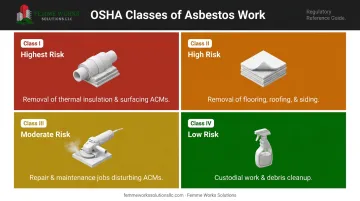
This standard is so detailed that it divides asbestos work into four distinct classes based on risk:
- Class I: Removal of the most hazardous materials, like thermal insulation around pipes and surfacing ACMs.
- Class II: Removal of other ACMs, such as asbestos flooring, roofing, and siding.
- Class III: Repair and maintenance jobs where disturbing ACMs is necessary.
- Class IV: Custodial work, like cleaning up dust and debris in areas with ACMs.
A key requirement of this OSHA standard is the on-site presence of a "Competent Person." This isn't just a site foreman. A Competent Person is a supervisor with specific, documented training who can identify asbestos hazards and choose the correct control strategies. They also have the authority to stop work immediately to correct a problem.
Key Differences: Why Abatement Isn't Just Another Construction Task
Confusing abatement with construction happens, but the on-site procedures and legal requirements are worlds apart. Here’s a direct comparison.
Regulatory and Legal Framework
Standard construction follows local building codes, but asbestos abatement is governed by a much stricter set of federal and state health laws. The two most important are OSHA's 1926.1101 standard and the EPA's National Emission Standards for Hazardous Air Pollutants (NESHAP).
NESHAP requires property owners and contractors to notify the appropriate environmental agency in writing, often 10 working days before work begins on projects exceeding a certain size. This level of advance notification isn't required for putting up drywall.
On-Site Safety and Containment Protocols
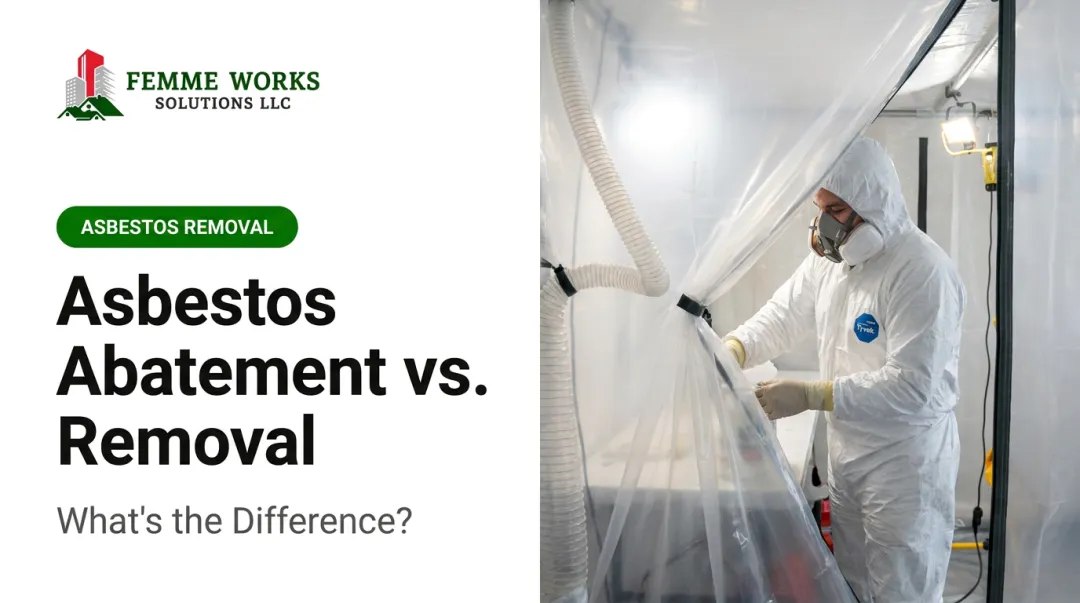
A construction crew might put up a plastic sheet to control dust. An asbestos abatement team builds a regulated containment area. This involves:
- Creating critical barriers by sealing all windows, doors, and vents with thick plastic sheeting to form an airtight seal.
- Establishing negative air pressure enclosures using HEPA-filtered machines. This creates a vacuum that ensures air flows into the containment zone if a leak occurs, not out.
- Building multi-stage decontamination units (airlocks) that workers must pass through when entering or exiting. This system ensures no fibers escape on their bodies or clothing.
Personnel Training and Certification
A general construction worker learns on the job. An asbestos abatement worker must be formally trained and certified. The EPA requires abatement workers and supervisors to complete accredited training courses (often 4-5 days long) and pass an exam, followed by annual refresher courses.
This is why choosing a specialized firm is non-negotiable. A company like Femme Works Solutions employs fully certified and insured professionals who are compliant with all EPA, OSHA, and Massachusetts DEP protocols. This level of verified expertise is a legal requirement, not just a nice-to-have.
Air Quality and Environmental Monitoring
In a typical renovation, no one tests the air for wood dust. During and after asbestos abatement, however, air monitoring is mandatory.
Professionals take samples inside and outside the containment area to ensure fiber concentrations remain below the strict OSHA Permissible Exposure Limit (PEL) of 0.1 fibers per cubic centimeter of air. Final "clearance" air testing is required before the containment can be taken down.
Required Equipment and PPE
A construction worker's PPE usually consists of a hard hat, safety glasses, and steel-toed boots. For asbestos abatement, the requirements are far more stringent and may include:
- Full-body disposable coveralls, gloves, and foot coverings.
- Specialized respirators, such as Powered Air-Purifying Respirators (PAPRs), which provide a constant flow of filtered air.
- HEPA (High-Efficiency Particulate Air) vacuums designed to capture microscopic asbestos fibers.
- Wet methods and chemical surfactants to dampen asbestos materials and prevent fibers from becoming airborne during removal.
Waste Disposal
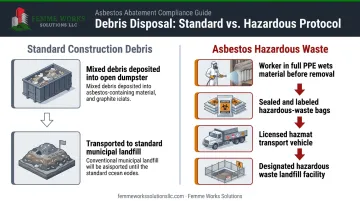
Construction debris goes into a dumpster and is hauled to a standard landfill. Asbestos waste, in contrast, is a hazardous material with strict disposal protocols.
It must be wetted, sealed in specially labeled and leak-proof containers, and transported by a licensed hauler to a designated hazardous waste landfill. A "waste shipment record" tracks the material from the job site to its final destination, creating a chain of custody.
The High Stakes of Misclassification: Risks of Treating Abatement Like Construction
Hiring an unqualified contractor to "just rip it out" can lead to disastrous consequences for property owners and contractors alike.
Health and Safety Risks
The primary risk is the uncontrolled release of asbestos fibers. According to the Centers for Disease Control and Prevention (CDC), breathing in these fibers can lead to debilitating and fatal diseases years later, including asbestosis, lung cancer, and mesothelioma. Improper removal endangers not only the workers but also anyone who enters the building for years to come.
Legal and Financial Penalties
Regulators do not take these violations lightly. Fines from OSHA and the EPA can be staggering. Per OSHA's penalty schedule, willful or repeated violations can cost over $165,000, with other serious violations costing over $16,000 per day.
The EPA can also levy its own significant fines for NESHAP violations. Beyond financial penalties, regulators can shut down the entire project, leading to expensive delays and legal battles.
Property and Liability Issues
A botched removal job doesn't remove the problem—it spreads it. Microscopic fibers can contaminate the entire property, including the HVAC system, carpets, and furniture.
The cost to decontaminate a whole building is exponentially higher than proper abatement. For property owners, this long-lasting liability can impact property value and future sales.
Frequently Asked Questions
Is asbestos abatement a service or construction?
It is a specialized environmental remediation service. While it falls under OSHA's "construction" standard because it happens on construction sites, its primary purpose is hazard removal and health protection, not building.
Can you be in a building during asbestos abatement?
No. Occupants are prohibited from entering the regulated work area. Depending on the project's scale and the building's HVAC system, adjacent zones or the entire property may also need to be vacated for safety.
What are the different classes of asbestos work?
OSHA defines four classes based on risk. Class I is the highest risk (e.g., removing pipe insulation), while Class IV is the lowest (e.g., custodial cleanup), each with its own specific set of rules and procedures.
What qualifications should an asbestos abatement contractor have?
A qualified contractor must have state licensing (required in MA), proof of EPA/OSHA compliance, certified training for all staff, and specific asbestos insurance. Also, verify their documented safety record and client reviews.
How is asbestos waste disposed of differently than construction debris?
Asbestos is hazardous waste. It must be sealed in labeled, leak-proof bags and transported to a special landfill that is permitted to accept it, unlike regular construction debris that goes to a standard C&D landfill.