This is where "demolition-free mold remediation" enters the picture. It’s marketed as an ideal solution—a way to eliminate mold without the hassle and expense of tearing out walls. But when it comes to protecting your property and family, does this seemingly perfect alternative actually work?
This guide will provide a clear, evidence-based answer. We’ll break down what these methods are, why they often fail, and what truly effective mold remediation looks like according to industry experts.
TL;DR: The Verdict on Demolition-Free Mold Remediation
- It’s a temporary fix at best. Methods like fogging or chemical sprays are generally ineffective as a standalone solution for significant mold problems.
- It misses the root cause. These techniques fail to address the underlying moisture source, which is the reason mold grew in the first place.
- It doesn’t remove the problem. Mold colonies growing inside porous materials like drywall and insulation are left behind, even if surface mold is killed.
- True remediation requires removal. The only way to solve a mold problem for good is to physically remove contaminated materials and fix the water issue.
What Is Demolition-Free Mold Remediation? (The Appealing Pitch)
Demolition-free mold remediation refers to any method that attempts to kill mold using chemical fogs, sprays, or biocides without physically removing the affected building materials. You might see it advertised under names like "mold fogging," "dry fogging," or "mold bombing."
The sales pitch is compelling. Companies claim this approach solves the problem faster, with less disruption, and at a lower cost than traditional remediation. It sounds like you can avoid the mess of demolition and get back to normal life quickly.
However, this approach is not a substitute for the comprehensive process recommended by leading authorities. Guidelines from the U.S. Environmental Protection Agency (EPA) and the Institute of Inspection, Cleaning and Restoration Certification (IICRC) are clear. True remediation isn't just about killing mold; it's about complete removal and prevention.
How Do "No-Demo" Methods Claim to Work?
These methods operate on a simple, surface-level principle: apply a chemical to kill the mold. While the specific product may vary, the process is usually straightforward and quick.
The Typical Process
- Apply a chemical solution: Technicians use a sprayer or "fogger" to disperse an antimicrobial mist, which is intended to settle on all surfaces.
- Allow for "dwell time": The chemical sits for a set period, claiming to penetrate surfaces and kill mold spores on contact.
- Wipe and ventilate: Accessible surfaces are wiped down and the space is aired out to clear fumes, leaving a "sanitized" smell.
On the surface, it seems logical. But this simple process overlooks the fundamental biology of mold and the complex nature of building science.
Why Demolition-Free Remediation Fails: A Reality Check
While fogging might eliminate some visible surface mold, it fails to address the core issues. This makes it a temporary and ultimately incomplete fix that can leave your home and health at risk.
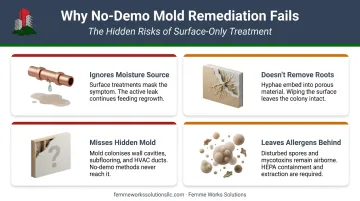
Problem 1: It Ignores the Moisture Source
Mold is a symptom of a bigger problem: excess moisture. Whether it’s from a leaky pipe, a cracked foundation, high humidity, or poor ventilation, water is the fuel. Spraying chemicals does absolutely nothing to fix the underlying water issue.
As the EPA clearly states, "The key to mold control is moisture control." If you don't stop the source of water, the mold is guaranteed to return, no matter how many times you spray it.
Problem 2: It Doesn't Remove the Mold's Root System
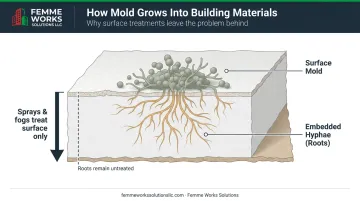
What you see on the surface of drywall or wood is often just the tip of the iceberg. Mold grows with root-like structures called hyphae, which embed deep into porous materials like drywall, insulation, carpet, and wood.
Surface sprays and fogs can't reach or remove these embedded roots. You might kill what's on the surface, but the organism remains alive and well within the material, ready to regrow as soon as conditions are right. It’s like trimming weeds but leaving the roots in the ground.
Problem 3: It Can't Reach Hidden Mold
Mold thrives in dark, damp, undisturbed places. It's frequently found growing behind walls, under flooring, in crawl spaces, or hidden in attic insulation. A chemical fog or spray simply cannot penetrate solid drywall or floorboards to treat these hidden colonies.
While you’re treating the visible mold in one area, a much larger infestation could be growing unchecked just out of sight, continuing to release spores and damage your home's structure. The World Health Organization estimates that 10-50% of indoor environments have issues with dampness and mold, many of which are not immediately visible.
Problem 4: Dead Mold Is Still an Allergen
This is a critical point that many homeowners miss. Even if a chemical spray successfully kills mold, the dead spores and their byproducts (mycotoxins) are left behind. These particles can still trigger allergic reactions, asthma attacks, and other respiratory issues.
The EPA confirms this, stating, "Dead mold may still cause allergic reactions in some people, so it is not enough to simply kill the mold, it must also be removed." Professional standards require the physical removal of mold contamination, not just killing it in place.
The Professional Standard: What Effective Mold Remediation Involves
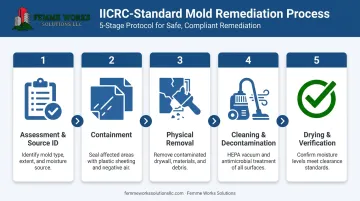
Industry-certified professionals follow a rigorous, science-backed process to ensure mold is not just treated, but completely and permanently removed. This process is outlined in the ANSI/IICRC S520, the industry's official standard of care for mold remediation.
Step 1: Assessment and Source Identification
A proper remediation job always starts with a thorough inspection. A certified professional will identify the full extent of the mold growth (both visible and hidden) and, most importantly, pinpoint the moisture source that’s causing it. A plan is then created to fix the water problem first.
Step 2: Containment
To prevent mold spores from spreading to unaffected areas of your home during removal, the contaminated area is sealed off. This involves using heavy-duty plastic sheeting to create physical barriers and employing negative air pressure machines to ensure contaminated air can't escape the work zone.
Step 3: Physical Removal of Contaminated Materials
This is the most crucial step and the one that "no-demo" methods skip. Any porous material that is contaminated with mold—such as drywall, insulation, carpet, and ceiling tiles—must be carefully cut out, bagged, and removed. This process, often called selective demolition, is the only way to get rid of the mold's root system.
Step 4: Cleaning and Decontamination
After contaminated materials are gone, the remaining semi-porous or non-porous materials (like wood studs or concrete) are thoroughly cleaned. This is done using a combination of techniques:
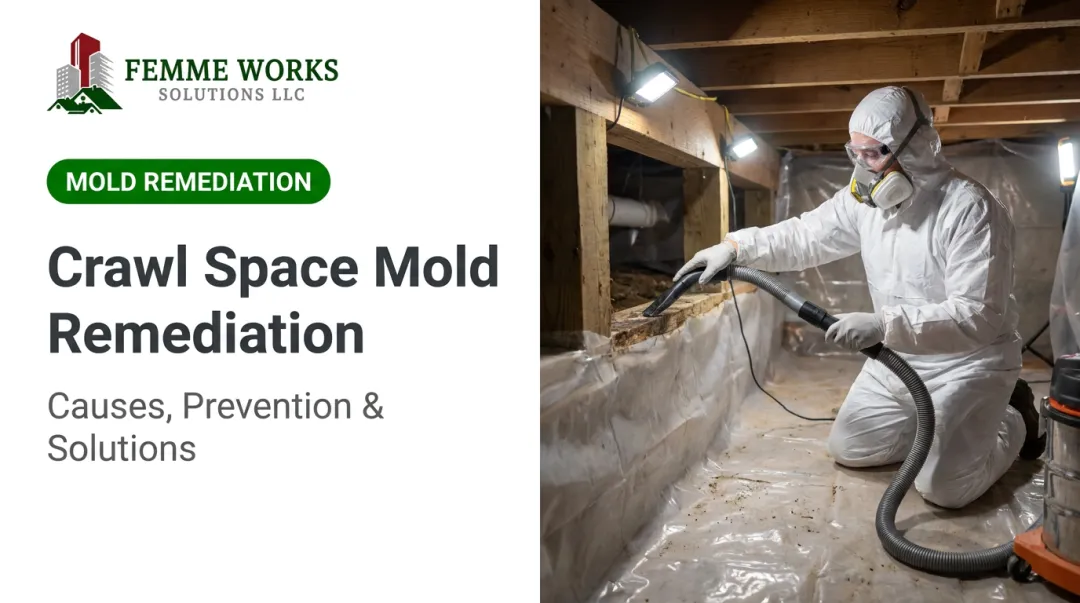
- HEPA Vacuuming: High-efficiency particulate air (HEPA) vacuums are used to capture microscopic mold spores from all surfaces.
- Wire Brushing & Damp Wiping: Surfaces are scrubbed and wiped down with antimicrobial cleaners to physically remove any remaining mold residue.
- HEPA Air Scrubbing: Industrial air filtration devices are run continuously to capture any airborne spores kicked up during the process.
Step 5: Drying and Post-Remediation Verification
Finally, the entire area must be thoroughly dried to ensure no moisture is left behind. Many reputable companies will also recommend an independent, third-party air quality test to verify that the remediation was successful and the area is safe to occupy.
At Femme Works Solutions, we follow this exact, comprehensive approach on every project. Our technicians are trained in IICRC-standard mold remediation and the precise selective demolition required to eliminate the problem for good.
Serving Massachusetts and New Hampshire, we remove only what's necessary while ensuring the mold is fully resolved according to the industry's highest standards.
Frequently Asked Questions
Is there a way to get rid of mold without tearing down walls?
For very minor surface mold on non-porous materials like tile or glass, you can often clean it yourself. However, for mold growing on or inside porous materials like drywall or wood, physical removal is almost always necessary for a permanent solution.
How much should mold remediation cost?
Costs vary widely depending on the size of the affected area, the extent of the damage, and the complexity of the repairs needed to fix the moisture source. It’s always best to get multiple detailed quotes from certified and insured professionals.
What to do if I can't afford mold remediation?
First and foremost, do whatever you can to stop the moisture source—this will halt further mold growth. Next, contact your homeowner's insurance company to see if your policy covers mold damage. Some remediation companies may also offer financing options.
Can I just use bleach to kill mold?
No, the EPA advises against using bleach on porous surfaces like drywall. Bleach only kills surface mold, while its water content can soak in and feed deeper growth, ultimately worsening the problem.
What are the health risks of incomplete mold remediation?
Incomplete removal leaves behind spores and mycotoxins that can cause chronic health issues. Symptoms often include persistent allergic reactions, asthma attacks, and other respiratory problems.
What is the IICRC S520 standard for mold remediation?
The IICRC S520 is the industry's official standard of care for professional mold remediation. It provides a blueprint for proper containment, removal, and safety protocols. Always hire a certified company that adheres to this standard.