But is the program working fairly for everyone? A recent report from the State Auditor’s Office raises serious questions. It reveals that many communities—particularly those with lower incomes—may be paying more than their fair share while receiving far fewer benefits.
This article will break down the auditor's findings and explain what they mean for you. We'll explore why these inequities exist and, most importantly, show how homeowners can overcome common barriers to access the energy savings they're already paying for.
TL;DR: Key Takeaways from the Mass Save Inequity Report
- Lower-income and Environmental Justice communities pay more into Mass Save than they receive.
- Renters and urban residents often can't access property upgrades but still fund the program.
- Hazardous materials like asbestos in older homes can block access to Mass Save incentives.
- The auditor recommends improved transparency, better renter incentives, and stronger program oversight.
What is the Mass Save Program & Why is it Under Scrutiny?
What is the Mass Save Program & Why is it Under Scrutiny?
Mass Save is a partnership between Massachusetts' largest gas and electric utility companies, including Eversource, National Grid, and Cape Light Compact. It’s designed to provide energy efficiency services, rebates, and incentives to residents and businesses across the state.
Crucially, the program is funded by a surcharge on every ratepayer's gas and electric bill. This means if you pay a utility bill in Massachusetts, you are contributing to Mass Save.
The program is now under scrutiny because of a report from the Office of State Auditor Diana DiZoglio titled Who Pays and Who Gains?. The report analyzed who pays into the fund versus who actually receives the financial benefits from rebates and incentives. The findings revealed a critical imbalance: while all ratepayers contribute, the program fails to benefit all communities equally.
Decoding the State Auditor's Report: Key Findings on Inequity
The auditor's report highlights several key areas where the Mass Save program falls short of its goal to serve all residents equitably.
The Financial Imbalance: Who Pays vs. Who Benefits?
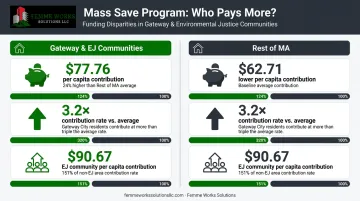
The core finding is a significant financial imbalance. Many lower-income municipalities, Gateway Cities, and Environmental Justice (EJ) communities contribute far more per person than they receive in program benefits.
According to the State Auditor's report, the numbers are stark:
- Residents in Gateway Cities contributed $77.76 per capita, which is 24% higher than the average for residents outside of these cities.
- When adjusted for income, Gateway City residents contribute to Mass Save at a rate 3.2 times higher than the average state resident.
- The disparity is even more pronounced in EJ communities. Residents in areas with over 90% EJ populations contributed $90.67 per capita, which is 151% of the per-capita contribution from communities with no EJ populations.
This data shows that the residents who could benefit most from energy savings are often subsidizing upgrades in wealthier communities.
The Renter and Urban Density Disadvantage
The report also found that as population density and the percentage of renters increase, the benefits received from Mass Save decrease. This happens for a few key reasons:
- Split Incentives: Landlords are responsible for major upgrades but don't pay the resulting energy bills, while tenants do. This disconnect removes the financial incentive for property owners to invest in efficiency.
- Logistical Hurdles: Implementing major energy upgrades in large, multi-unit buildings can be more complex than in a single-family home.
- Structural Barriers: Older housing stock in these communities often has pre-existing hazards like asbestos or mold. These issues must be remediated by a certified contractor before Mass Save weatherization can proceed, creating an additional cost barrier.
The result? Only 7% of high-density municipalities received more in Mass Save benefits than they contributed.
Lack of Transparency in Funding
Another major criticism in the report is the lack of transparency on utility bills. The Mass Save surcharge is often bundled with other fees, like a "distribution adjustment charge," rather than being clearly itemized. This leaves most consumers unaware of exactly how much they contribute to the program each month. The report called the current billing structure "unnecessarily opaque."
Key Recommendations for a Fairer Program
To address these issues, the State Auditor's Office proposed several key recommendations, including:
- Transferring Mass Save administration to an independent body.
- Increasing legislative oversight of the program.
- Developing better, targeted incentives to encourage landlords to participate.
- Restructuring utility bills to clearly itemize Mass Save charges.
The Real-World Impact: A Tale of Two Communities
To understand what this data means in practice, let's look at two hypothetical scenarios that illustrate the report's findings.
Scenario 1: A Homeowner in a High-Benefit Suburb
A homeowner in a suburban town schedules a no-cost Home Energy Assessment through Mass Save. An advisor comes to their home, provides free LED lightbulbs, and identifies that their attic insulation is insufficient.
The process is seamless. The homeowner qualifies for a 75% rebate on new insulation and thousands of dollars off a new, energy-efficient heat pump. Within a few weeks, the work is done.
They see an immediate drop in their energy bills—a direct return on the money they've been contributing through their utility bills for years.
Scenario 2: A Renter in a Gateway City
Now, consider a family renting an apartment in a triple-decker in Lawrence. Their energy bills are sky-high due to poor insulation. Their landlord schedules a Mass Save assessment, hoping to get the 75% insulation rebate.
During the assessment, the advisor discovers that the attic contains old vermiculite insulation, which is presumed to contain asbestos. This is a pre-weatherization barrier. The home is now ineligible for any Mass Save insulation work until the hazardous material is professionally removed.
The remediation costs thousands of dollars, an expense the landlord is unwilling to cover. As a result, the project stalls. The family is left with high energy bills and an unsafe material in their home, continuing to pay into Mass Save with no way to access benefits until the hazardous material is professionally removed.
How Femme Works Solutions Helps Bridge the Access Gap
This second scenario is where the system breaks down for thousands of residents. The "pre-weatherization barrier" is a common problem in the older housing stock of Gateway Cities, effectively locking people out of the program.
This is the exact gap that Femme Works Solutions was created to fill. As a certified, woman- and minority-owned business, we help residents overcome these barriers by specializing in the safe removal of asbestos and vermiculite—the essential first step to unlocking Mass Save benefits.
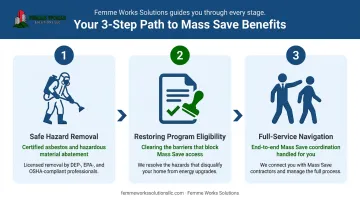
Our process ensures homeowners can access these energy-saving upgrades:
- Safe Hazard Removal: Our licensed team removes asbestos and vermiculite in full compliance with all state and federal regulations.
- Restoring Program Eligibility: Once the hazardous material is gone, the home qualifies for Mass Save's insulation and weatherization upgrades.
- Full-Service Navigation: We help you navigate the entire process, providing the documentation needed to secure your incentives.
This hands-on support is central to our commitment to equity. As a certified MBE/WBE with a bilingual Spanish-speaking team, we are dedicated to serving the very communities that the auditor's report found were being left behind.
Moving Towards an Equitable Energy Future
The Mass Save program is a vital tool for helping Massachusetts meet its climate goals and for helping residents save money. However, the State Auditor's report makes it clear that significant improvements are needed to ensure fairness and equity for everyone.
While systemic changes are necessary, you don't have to wait for new legislation to take action. If you suspect a barrier like asbestos is keeping you from accessing Mass Save benefits, your first step is to work with a certified remediation partner.
Removing these hazards allows you to turn your monthly contribution into a real return on investment: a safer, more affordable, and more comfortable home.
Frequently Asked Questions
Who funds the Mass Save program?
Mass Save is funded by all Massachusetts gas and electric ratepayers. A small surcharge, called an Energy Efficiency Charge, is added to every monthly utility bill to support the program's rebates and services.
Does the Mass Save program have income limits?
The general program is open to all residents, but enhanced offers and no-cost services are available for low- and moderate-income households through dedicated income-eligible programs.
Is the Mass Save program legitimate?
Yes, Mass Save is a legitimate, state-approved energy efficiency initiative. It is administered by the state's major utility companies under the oversight of the Department of Public Utilities.
How can renters benefit from the Mass Save program?
Renters can receive a no-cost energy assessment and instant savings measures like LED bulbs and advanced power strips. Larger upgrades, such as insulation or new heating systems, require landlord approval and investment.
What is a "Gateway City" and why are they mentioned in the report?
Gateway Cities are mid-sized urban centers in Massachusetts facing historical economic challenges. The report highlights them because it found their residents tend to pay more into the program than they receive in benefits.
What if my home needs asbestos removal before I can get Mass Save insulation?
Asbestos is a "pre-weatherization barrier" that requires removal by a licensed contractor before Mass Save insulation work can begin. Remediation companies like Femme Works Solutions handle this to make homes eligible for program incentives.