A Hazardous Material Management Plan (HMMP) is the formal document that outlines every procedure for safely handling, storing, and disposing of these materials. It’s not just a regulatory hurdle to clear for OSHA, the EPA, and local fire departments. A well-crafted HMMP is the foundation of a proactive safety culture that protects your employees, the surrounding community, and the environment.
This guide provides a clear framework and a sample template to help you build an effective HMMP that ensures both safety and compliance.
TL;DR: Your Quick Guide to HMMPs
- An HMMP is a written plan detailing how your facility manages hazardous materials from receipt to disposal.
- It's required for compliance with federal (OSHA, EPA) and local regulations (e.g., International Fire Code).
- Key components include a materials inventory, facility maps, emergency plans, and training protocols.
- The goal is to minimize risk, ensure employee safety, and prepare for any potential emergencies.
What Is a Hazardous Material Management Plan (HMMP)?
An HMMP is a comprehensive, site-specific document that establishes the policies, procedures, and responsibilities for managing chemicals and other hazardous substances safely. Its primary purpose is to prevent and mitigate accidental releases, fires, or exposures, ensuring both operational safety and full regulatory compliance.
This plan acts as the central hub for your hazard management system. While it complements other safety documents, it serves a unique purpose:
- Safety Data Sheets (SDS) provide hazard details for a single chemical. In contrast, the HMMP is a site-wide operational plan for managing all materials collectively.
- Tier II Reports are annual filings informing emergency responders what you have on-site. The HMMP is your internal, day-to-day playbook for how you manage those chemicals safely.
Understanding these differences is crucial, as the need for an HMMP is driven by key regulations like OSHA's Hazard Communication Standard (29 CFR 1910.1200), the EPA's Resource Conservation and Recovery Act (RCRA) for waste, and local fire codes. Many of these codes are based on the International Fire Code (IFC).
Why Your Business Needs a Hazardous Material Management Plan
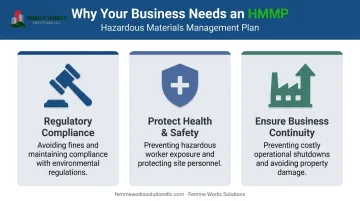
Maintaining a current and accurate Hazardous Material Management Plan (HMMP) isn't just good practice—it's a legal and financial necessity for any business handling regulated substances.
Regulatory Compliance and Avoiding Penalties
First and foremost, it’s the law. Federal agencies like OSHA and the EPA, along with state and local fire authorities, mandate these plans. Failure to comply is not a minor issue. In fact, OSHA's Hazard Communication standard is consistently one of the most frequently cited violations year after year.
Penalties for non-compliance can be severe. For example, Parker Hannifin paid a $366,000 EPA penalty in 2024 for hazardous waste violations. These included inadequate staff training and inspection failures, both of which a proper HMMP is designed to prevent.
Protecting Employee and Community Health
A robust HMMP directly translates to a safer workplace. It minimizes the risk of chemical exposure, fires, and explosions. Thousands of U.S. workers get sick from chemical exposure annually. An HMMP's clear safety protocols are a critical part of an employer's responsibility to prevent these incidents.
Ensuring Business Continuity
A hazardous material incident can bring your operations to a grinding halt. The costs of an accidental release go far beyond regulatory fines, threatening your entire operation. For instance, the U.S. Chemical Safety Board reported that 30 serious chemical incidents between 2020 and 2025 caused approximately $1.8 billion in property damage.
A well-executed HMMP helps prevent these costly shutdowns, limits environmental cleanup liabilities, and protects your company's reputation.
The Core Components of an Effective HMMP: A Sample Template
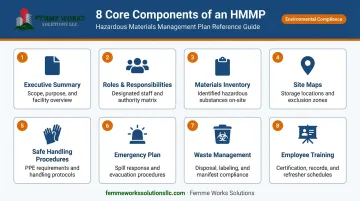
While every HMMP must be tailored to a specific facility, all strong plans contain the same essential sections. You can use the following structure as a template to build or update your own plan.
1. Executive Summary & Plan Objectives
This section provides a high-level overview. It should briefly describe the facility's operations, state the purpose of the HMMP, and list its primary objectives.
Objectives may include:
- Ensuring 100% compliance with federal, state, and local regulations.
- Protecting the health and safety of all personnel, visitors, and the community.
- Preventing spills and accidental releases of hazardous materials.
- Establishing clear procedures for emergency response.
2. Roles and Responsibilities
A plan is useless without clear ownership. This section must detail who is responsible for implementing, maintaining, and enforcing the HMMP.
- EHS Coordinator/Facility Manager: Oversees the entire plan, ensures annual reviews, and acts as the primary contact for regulatory agencies.
- Department Supervisors: Responsible for implementing the plan within their departments, ensuring employees are trained, and conducting routine inspections.
- Employees: Responsible for following all safety procedures, using appropriate PPE, and reporting any hazards or incidents immediately.
3. Hazardous Materials Inventory
This is the heart of your HMMP. It is a comprehensive list of every hazardous material on-site. The inventory must be kept current and should include:
- Product Name (as it appears on the container and SDS)
- Chemical Abstract Service (CAS) number
- Maximum quantity stored on-site
- Specific storage location(s)
- Associated hazards (e.g., flammable, corrosive, toxic)
4. Site and Storage Maps
Visuals are critical. The plan must include up-to-date diagrams of the facility that clearly show:
- Where each hazardous material is stored.
- The locations of all safety equipment (e.g., fire extinguishers, eyewash stations, spill kits).
- Emergency evacuation routes and assembly points.
- Locations of main utility shutoffs (gas, water, electric).
5. Safe Handling, Use, and Storage Procedures
This section outlines the specific, day-to-day procedures for managing your materials safely. It should cover requirements for proper chemical labeling, mandatory Personal Protective Equipment (PPE) for specific tasks, and protocols for storing incompatible materials separately to prevent dangerous reactions.
6. Emergency Response and Spill Contingency Plan
What happens when something goes wrong? This section must detail the exact procedures for responding to different types of emergencies, such as spills, fires, or medical incidents involving chemical exposure.
It must also include a clear list of internal and external emergency contacts with names and phone numbers, such as the Fire Department, Poison Control, and the facility's emergency coordinator.
7. Waste Management and Disposal Procedures
Your responsibility doesn't end until hazardous waste is properly disposed of. This section must explain how your facility identifies, stores, and disposes of hazardous waste in full compliance with EPA RCRA regulations.
For highly regulated materials like asbestos and mold, your plan must specify the use of certified professionals for handling and disposal to ensure safety and compliance.
Businesses in Massachusetts and New Hampshire can partner with a licensed contractor like Femme Works Solutions for this step, guaranteeing full adherence to all DEP, EPA, and OSHA protocols.
8. Employee Training Program
A plan is only effective if your team knows it exists and understands how to follow it. This section must describe the training requirements for all employees who handle hazardous materials.
This includes initial training upon assignment, annual refresher courses, and immediate updates when a new hazard is introduced. Training should cover the HMMP itself, how to read an SDS, and all emergency procedures.
Key Factors That Influence Your HMMP
Not all HMMPs are created equal. The complexity and rigor of your plan will depend on several key factors specific to your operations.
- The types and quantities of materials on-site determine the plan’s complexity. A facility with a few cleaning chemicals has simpler needs than a plant storing flammable liquids above the Maximum Allowable Quantities (MAQs) set by local fire codes.
- How you use and handle chemicals changes the plan's focus. A manufacturing plant with active processing needs detailed handling procedures, while a warehouse simply storing sealed products has fewer requirements.
- Your facility's location and its local regulations are crucial. Local fire and environmental departments often have rules for permitting, reporting, and emergency planning that go beyond federal mandates, so you must check their specific requirements.
Common Mistakes to Avoid in Hazardous Material Management
Creating the HMMP is the first step; maintaining it is the ongoing challenge. Here are some of the most common—and dangerous—pitfalls to avoid.
- Outdated Inventory and Maps: An inaccurate plan is useless in an emergency. The HMMP must be a living document, updated whenever new chemicals are introduced, processes change, or storage locations move.
- Inadequate Employee Training: A signed training log isn't enough. If your team can’t execute safety and emergency procedures, the plan is just a binder on a shelf. Training must be practical, ongoing, and verified.
- Poor Accessibility: The HMMP must be readily accessible to all employees on all shifts. Locking the only copy in a manager's office defeats its purpose as a practical safety tool.
- Incorrect Waste Identification: Misclassifying hazardous waste is a common and costly violation. It can lead to improper disposal, significant environmental liability, and steep fines from the EPA.
Avoiding these common mistakes transforms your HMMP from a document into a core part of your safety culture. When your plan identifies specific hazards like asbestos, vermiculite, or mold, the next critical step is safe removal—a task for certified environmental remediation experts.
Frequently Asked Questions
What is a Hazardous Material Management Plan (HMMP)?
An HMMP is a site-specific safety and compliance document. It outlines a facility's procedures for safely handling, storing, using, and disposing of hazardous substances to protect people and the environment.
Who needs an HMMP?
Any business that handles hazardous materials above certain quantities is typically required to have one. These thresholds are defined by federal agencies like OSHA and the EPA, as well as local fire codes.
What should be included in an HMMP?
Core components include a complete hazardous materials inventory, site maps, safe handling procedures, emergency response plans, waste management protocols, and an employee training program.
How is an HMMP different from a Safety Data Sheet (SDS)?
An SDS provides detailed hazard information for a single chemical product. An HMMP is a comprehensive, facility-wide plan for managing all hazardous materials and their associated processes.
How often does an HMMP need to be reviewed or updated?
It should be reviewed at least annually. More importantly, it must be updated immediately whenever new chemical hazards are introduced, storage locations change, or operational processes are modified.
Can our company create its own HMMP or do we need a consultant?
Many companies can create their own plan, but hiring a certified environmental contractor is wise for complex operations. Professionals ensure all regulatory details are covered, guaranteeing compliance and safety.