

You’re probably here because someone mentioned “asbestos” during a home inspection or while you were planning a renovation. Take a deep breath. Let’s walk through this together.
After 15 years working with families across Massachusetts, we know asbestos sounds scary. But most of that fear comes from not fully understanding what it is, where it’s found, and when it’s actually dangerous. We’re going to give you clear, straight answers — the same way we explain it to our clients every day.
What is asbestos?
This might surprise you… Asbestos is natural. It’s not a man-made chemical. It’s a mineral that forms in the earth and has been around for millions of years.
So why is something natural such a problem?
Because of how it’s built. Asbestos is made up of microscopic fibers that can withstand temperatures above 1,000°C without breaking down. It doesn’t burn. It resists chemicals. It’s incredibly durable. For 20th-century construction, it was considered a miracle material, affordable, abundant, and incredibly effective.
Asbestos as a naturally occurring mineral
When we talk about asbestos, we’re actually referring to a family of minerals. The three most common types found in Massachusetts are:
Chrysotile (white asbestos) – Accounts for about 95% of asbestos used in construction
Amosite (brown asbestos) – Less common in residential homes
Crocidolite (blue asbestos) – The least common, but the most hazardous
The key thing they all share? Their fibers are about 100 times thinner than a human hair. Invisible to the naked eye, they can float in the air for hours. Once inhaled, your body cannot break them down or remove them. They stay there — permanently.
Why was asbestos so widely used in construction?
Put yourself in the shoes of a builder in 1950. World War II has just ended. There’s a housing boom. Families need safe, fire-resistant homes — fast.
Along comes asbestos. Fireproof. Cheap. Easy to install. Abundant. At the time, builders didn’t fully understand the long-term health risks. Based on the information available back then, it seemed like the perfect solution.
From the 1940s through the late 1970s, asbestos was the standard. If your Massachusetts home was built during that time, there’s a strong chance it contains asbestos. Not because it was poorly built — but because that’s simply how construction was done.
Key properties that made asbestos so popular
Asbestos seemed ideal because it is:
- Highly fire-resistant (can withstand over 1,000°C)
- An exceptional thermal insulator
- Resistant to corrosion
- Extremely durable
- Versatile (it was mixed into dozens of products)
- Cost-effective
From a builder’s perspective, it was a dream material. The part that wasn’t widely understood? It can cause serious disease decades later.
Common building materials that may contain asbestos
If your home was built before 1980, pay close attention. These are areas where we find asbestos every single week:
Basement & Heating Systems
- White or gray pipe insulation wrap
- Boiler insulation
Flooring
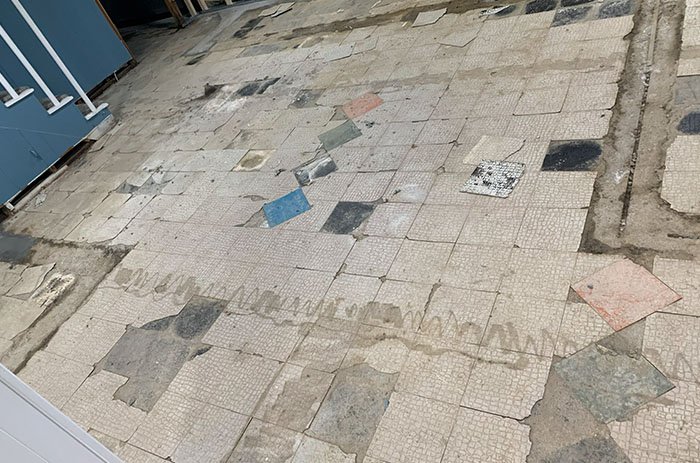
- 9×9 vinyl floor tiles
- Black mastic (adhesive underneath tiles) — often contains asbestos
Attic
- Vermiculite insulation (loose-fill, gray or gold pebble-like material) sold between 1920–1990
Walls & Ceilings
- Older wall panels
- Joint compound
- “Popcorn” ceilings from the 1960s–70s
Exterior
- Cement siding shingles
- Fiber cement panels
Maybe your grandparents lived in a home full of asbestos and never had issues. Why? Because it was intact and undisturbed. The real danger begins when it’s cut, scraped, drilled, sanded, or otherwise disturbed.
Why is asbestos considered dangerous?
Companies mining asbestos knew as early as the 1920s and 1930s that it caused serious health problems. There are documented records proving it. Yet it continued to be installed in millions of homes, schools, and hospitals for decades.
When Does Asbestos Become a Health Risk?
Here’s something important: asbestos that is intact and in good condition is generally not dangerous. If it’s sealed, stable, and undisturbed, the risk is minimal. You are not in immediate danger.
The real risk comes when asbestos becomes friable — meaning it can crumble under hand pressure.
This often happens when:
- Renovating floors and scraping black adhesive
- Cutting pipe insulation
- Water damage soaks vermiculite insulation
- Natural aging and deterioration
- Sanding or scraping popcorn ceilings
We regularly meet homeowners who start a DIY project, only to discover halfway through that they’ve disturbed asbestos. Cleanup and professional decontamination can become extremely expensive.
Before you break, cut, or demolish anything in a pre-1980 home, you need to know what’s there.
How asbestos fibers affect the human body
When asbestos fibers are inhaled, they travel deep into the lungs. Because they’re so small, they bypass the body’s natural defenses.
Once lodged in the lungs, they stay there. Your body responds by forming scar tissue around each fiber. Over time, that scarring builds up.
The most alarming part? Symptoms can take 10 to 40 years to appear. Exposure at 30. Diagnosis at 60 or 70.
Diseases linked to asbestos exposure
- Asbestosis. Permanent lung scarring, no cure
- Lung cáncer. Significantly increased risk, especially for smokers
- Mesothelioma. Rare, aggressive cancer; average prognosis 12–21 months. No cure.
There is no “safe” level of exposure. Every fiber increases risk.
Why is asbestos still a concern today?
Although asbestos use declined in the late 1970s, removing every trace of it from every building would cost trillions of dollars and is logistically impossible.
Because intact asbestos isn’t automatically dangerous, the strategy in the U.S. is management, not total removal. It’s typically removed during renovations, demolitions, or when materials deteriorate.
Asbestos in Older Massachusetts Homes
Massachusetts has one of the oldest housing stocks in the country. Roughly 75% of homes built before 1980 contain some form of asbestos. That’s hundreds of thousands of properties.
The historic homes people love often need updates, electrical systems, insulation, kitchens, bathrooms. Every improvement has the potential to disturb asbestos.
The good news? Massachusetts has strict regulations in place. Programs like Mass Save may even help offset part of the removal cost in certain situations.
Asbestos in more recent properties
Here’s something that surprises many homeowners, asbestos has never been fully banned in the United States. Some products that are still legal may contain asbestos.
Buildings constructed in the 1980s and even early 1990s may contain leftover inventory materials. We’ve tested homes built in 1985 that contained asbestos.
The only way to know for sure? Professional testing.
Who should be concerned about asbestos?
Asbestos can be present in older homes and buildings, and it becomes a health risk if handled improperly. Homeowners, real estate professionals, and contractors all need to understand when to be concerned, and what to do next.
Homeowners
If your home was built before 1980 and you are:
- Planning a renovation
- Noticing material deterioration
- Recently purchased the property
- Simply seeking peace of mind
Schedule asbestos testing. It typically costs a few hundred dollars. Remediating contamination after the fact can cost $10,000–$30,000 or more.
Real Estate agents & property managers
Disclosure of known asbestos is often legally required. A surprise during inspection can derail a sale.
Proactive agents test before listing, eliminate surprises, and help transactions close faster.
Contractors & Renovation Teams
Massachusetts enforces strict asbestos regulations. Fines can reach up to $25,000 per day.
Your license, insurance, and reputation are at stake. Before working on pre-1980 properties, inspection is critical. If asbestos is found, certified professionals must handle it.
What Do We Recommend at Femme Works Solutions?
Every situation is different. The right approach depends on your home’s age, the condition of the materials, and what you’re planning to do next. But after 15 years of working with homeowners across Massachusetts, here’s the practical advice we give every day.
If you’re planning a renovation
Get an asbestos inspection before starting work. Budget for professional removal if needed.
If you know you have asbestos
If it’s intact, there’s no immediate danger. Document its location. Monitor it every six months. Develop a management plan.
If you’re not sure
That’s where we come in.
At Femme Works Solutions, we’ve been helping Massachusetts families for over 15 years. We perform thorough inspections, answer your questions clearly, and if removal is required, we handle it safely, legally, and transparently.
We offer:
- Professional inspections with certified laboratory analysis
- Clear estimates with no hidden fees
- Assistance navigating Mass Save programs
- Fully licensed, regulation-compliant removal services
Contact our team today and get real answers. We’re right here with you.

